Saturday, 3 December 2011

Ann Patchett's "State of Wonder"

Read: November 19, 2011

This book was my first exposure to Ann Patchett, who from the reactions some have given me to that statement seems to be a relatively popular author with a devoted fanbase. I came across this most recent of her books because a book club I joined first picked The Elegance of the Hedgehog before giving it up (much to their loss, in my opinions). I will give the caveat here that reading State of Wonder under the shadow of Elegance of the Hedgehog probably influenced my reading of the former. They are very different kinds of novels. As I mentioned in my earlier post, Elegance of the Hedgehog is a very cerebral book that relies almost exclusively on characterization and witty language. State of Wonder, in contrast, emphasizes atmosphere over character.
State of Wonder follows Dr. Marina Singh, a research scientist at a pharmaceutical company in Minnesota. Originally trained as an OB Gyn, a horrific experience as an intern under the inimitable Dr. Annick Swenson’s mentorship led Marina to leave her internship and take up a research position. The novel opens with the news that Marina’s co-worker, Anders, has died in the Amazon jungle on a business trip to investigate Dr. Swenson’s work on a malaria vaccine. Marina’s boss, Mr. Fox, with whom she has a secret relationship, sends her to continue Anders’ investigation and, at Karen Eckman’s request, to learn more about Anders’ mysterious death. Once in South America, the novel finds its stride in the descriptions of the intense heat, heavy air, and dangerous insects. Marina’s antimalarial medicine gives her horrific nightmares about her father, an Indian man whom Marina and her American mother would visit infrequently. In these dreams, Marina loses her father in a large crowd of people and faces that inexplicable terror of nightmares. Once Marina successfully finds Dr. Swenson, who at 70 is just as abrupt and irascible as Marina remembers, the novel shifts focus away from the Anders mystery to a tree bark that gives both malarial immunity and lifelong fertility.
The atmospheric language that so aptly describes the sticky heat of the Amazon moves slowly through the plot and gives the impression that the story barely moves forward. Marina spends quite a long time in Manaus, a city in Brazil, before she makes it into the jungle and the plot gets very bogged down there. Perhaps my greatest complaint, though, is that with the shift of focus away from Anders and to the mystery of the tree bark, the ending (not to give away any spoilers) has the distinct feel of the deus ex machina (not to mention overly Hollywood in a way that is even more disappointing in print). Marina, as a character, is a rather passive woman with obvious daddy issues (both in her memories of her father and her relationship with Mr. Fox) and who seems incapable of making herself heard. I think it would be quite a challenge to write a main character like this, who is the perspective of the story but who does very little herself to push the story forward. I think in this she is a very realistic person, but the conclusion leaves her story feeling unfinished (and obviously lacks any state intention on her part).
Ultimately, I would not recommend this book. It might be one that I should return to and reevaluate outside of the context I mentioned above, but ultimately, I think there wasn’t enough in the book to make me return to it.

Monday, 14 November 2011

Muriel Barbery's "The Elegance of the Hedgehog"

Read: October 30, 2011
I'm beginning to think I should start writing down why I add books to my "to read" shelf on Goodreads - is it a friend's recommendation, a good review (from where?), or a suggestion shelf at a trusted bookstore? That way, when I start these reviews, I'll be able to say more than "this book has been on my to-read list for a couple of months and I was excited to read it finally." Alas, I no longer remember why this book made my list, but when one of my book clubs recommended it, I seconded it enthusiastically. As it turned out, that might not have been for the best - the book seems to be a polarizing one. People either love it or hate it. I loved it, so perhaps that says more about me than about the book.
Translated from the French, The Elegance of the Hedgehog tells the story of two closet intellectuals. Paloma Josse is a twelve-year-old girl who has decided that the mundane existences she sees around her, especially those of her parents, her elder sister, and her neighbors in their upscale Parisian apartment complex do not provide any hope for a life worth living. She has decided that on her 13th birthday she will kill herself romantically in a fire and she is keeping a journal to record "the movements of the world," ostensibly in an attempt to convince herself that there is beauty worth living for. The rest of the novel is told from the perspective of Renee Michel, the concierge at Paloma's apartment building. An autodidact, who named her cat Leo after Tolstoy, she perceives herself as something of an unnatural/socially unacceptable intellectual. She keeps up a facade as the lowly concierge who spends her days watching daytime dramas and making overcooked commoner's food, while meanwhile she is reading great works of literature in the back bedroom and tasting fine wines and cheeses. The novel spends a lot of time getting to know these characters before Paloma discovers Renee's secret. A friendship develops between Renee, Paloma, and a new tenant, Mr. Ozu, who is the first to notice that Renee is not as prickly and common as she pretends.
The biggest complaint I've heard about the novel is that there isn't a plot and that the readers got tired of listening to these two narrators soliloquize with big words. I found this fascinating. It's a story that's told primarily though characterization, and beyond that, Barbery achieves this strong characterization entirely through what her two main characters tell about themselves. There are distinctive differences between Paloma's narration and Renee's, even when they talk about each other.
The novel meditates on questions of class, philosophy, what makes for good literature, film, the purpose of family, and the question of happiness. The characters (and by extension the author) were knowledgeable enough about these subjects so that the meditations were more than just passing references. In fact, reading this book gave me the feeling I had just had a deeply pleasing intellectual discussion with one of my best friends. When it comes to recommendations, my suggestion to people is that, once I’ve described it in all its glory and potential detractions, if it still sounds like a book they will enjoy, then absolutely read it, and quick. It’s not for everybody (in fact, some articles I read questioned whether it was an untranslatable European book that Americans will not understand or buy), but for those to whom it is addressed, it’s a treasure.

Saturday, 12 November 2011

Harriet Riesen's "Louisa May Alcott: The Woman Behind Little Women"

Read: October 14, 2011
I joined quite a few book clubs when my good friend in California vowed with me to meet new people and make new friends by Halloween (this entry is, obviously, very delayed). The Providence Public Library was fortunately just starting a new brown bag lunch book club. The PPL received a grant, I think, to celebrate Louisa May Alcott's life throughout this fall. The whole project included field trips to Orchard House, one of Louisa's homes and the setting for Little Women, as well as film screenings, a tour of Providence circa Louisa's time, and verbal performances. One of my favorite parts about moving to the northeast and to a city are these kinds of cultural events combined in a sense of neighborhood coherency, so I was excited to join. The library provided the books to the book club members as a loan - my guess is that my copy is now in circulation. I'm always a sucker for a free book, even if I have to give it back in the end. (The downside to not having the book anymore is that this entry, as well as the following one, are dreadfully late - I didn't have the book lying around as an increasingly loud reminder to write a blog entry.) The other complication is that when I read a book for a book club, I jot down notes for the discussion and then talk out my ideas rather than resorting to writing them down in this blog. I think in the future, though, I'll attempt to blog about the books before or immediately after the discussion so that I avoid these complications. (How many blogs do you think come with pledges to do better or write more frequently? Seems like an unavoidable element of the personal narrative.)

To the book. The author, Harriet Reisen, initially researched Louisa May Alcott for a documentary film and ended up uncovering enough new material to justify a book. In the forward to the book, Reisen discusses some of this new material, including a previously lost transcript of an interview with Louisa's niece as well as the identification of some several pop fiction novels that Alcott wrote and published under a pseudonym. Reisen said that she wanted the documentary, which I have yet to see, to come from almost entirely primary sources. Alcott, an avid journalist and prolific letter writer, certainly left behind a robust enough collection to make this possible. She is also one of the first authors to suffer/enjoy rampant celebrity during her own life (there were a couple of amusing anecdotes in the book where fans would arrive at her home and want to interview the real Jo). Because Alcott did not live in obscurity, much of this material remains in libraries, particularly the Houghton Library at Harvard. With all of these primary sources, Reisen has the material to construct a narrative replete with quotes from Alcott herself and her family members, from which the book greatly benefits.

Louisa and her family were closely involved with the Transcendentalist movement in Concord. Her father, Bronson Alcott, was a progressive educator more successful at lecturing about his methods than convincing people to entrust him with their children. For much of his life, he was sponsored by Ralph Waldo Emerson, and the Alcott family composed an important part of the literary circle Emerson built around his home in Concord. Reisen even hints that Louisa had a strong crush on Henry David Thoreau, who served as inspiration for more than one of her characters. The early part of the book pushes the theme that Louisa's childhood was not at all as bright and comforting as Little Women. Bronson proves himself unable to provide for his family sufficiently and consistently. Partly because of his personal politics (he often refuses payments for his lectures, or as he called them conversations, because he refuses to monetize education) but also possibly because of a personality disorder keeps him unfocused on day-to-day details. As an example, he becomes enthralled with the idea of living in a commune, brings his family, but does not plan thoroughly to keep the commune fed through the winter and ends up relying on local Quakers to survive. The family lives debt to debt; eventually even family refuses to loan them money. Reisen carefully trods the line between outlining the hardships and refraining from castigating Bronson. To my reading, he seemed more troubled by incomplete philosophies and probable mental deficiencies than an irresponsible reprobate, but the women in the book club generally took him to task.

The latter half of the book focuses on the tension Louisa faces between desiring independence (both without a husband and from her family) and financial obligations to her family (without which they probably could not survive). Louisa discovers early on that she can write for money, which results in the countless murder mysteries and romances  that she can jot off quickly for income. I find it interesting that the narrative of Little Women, in which Jo reaches the pinnacle of her writing career with a story about her own sisters, has so thoroughly determined how I thought of Alcott's own writing career. To the contrary, she did not really desire to write children's fiction, despite encouragement from her father and an interested editor. Even after the overnight success of Little Women, Alcott remained dissatisfied with her writing and continued to work towards some literary triumph (specifically in adult fiction). Reisen writes her literary career as a moderately-tuned down success story in which young Louisa vows to be wealthy and famous and ultimately accomplishes this beyond her wildest dreams, freeing herself from financial worries and achieving a fame that outstrips almost anything seen to this point in the history of celebrity. Despite this, I found Alcott's life rather sad. She always wanted to write that critically-acclaimed novel, and almost didn't notice the acclaim for Little Women. She was overwhelmed by the fans who treated her as a commodity. And just as she achieves enough wealth to settle her family's debts and live comfortably, first her mother dies and then her own health begins to decline. All that being said, the novel obviously pulls the reader in and successfully achieves an effective sense of empathy.

My greatest complaint with the book, which I'm noticing as a running theme of popular nonfiction, is that there weren't nearly enough sources. For example, the author would write about Louisa's feelings and thoughts at various points in her life, such as her relationship with her father, without providing citations to Louisa's own description of these things. I found myself thinking, at several points, "how could you possibly know that?" I think this is a function of the popular nonfiction book which prioritizes narrative development over academic proof. In this arena, it's more important to tell a coherent story than it is to defend every assertion. Perhaps less egregious, though just as annoying to me, was the conflation of text and author. As an English student, this was a major taboo - never assume that a thought or sentiment expressed in a piece by an author expresses that author's personal experience or thoughts. I think this is perhaps especially complicated with Alcott because she acknowledged quite frankly that Little Women is autobiographical; her elder sister began to refer to herself as Meg. In this situation, it makes a bit of critical sense to interpret Alcott's life through the text. However, this does not mean that everything she wrote can be interpreted biographically. Just because she wrote about women having adventures in murder mysteries and romances doesn't mean you can assume that Alcott herself felt trapped by conventions. It seems like an illogical circle to say that a character seems to physically resemble Thoreau, and therefore because the heroine of a text admires that Thoreau-like character, Alcott herself must have admired Thoreau. Assertions like that require mounds of citations and explications, which are obviously not suitable for a work of popular nonfiction. Perhaps I quibble, but I found it annoying, not least because Reisen had plenty of primary sources to use to explore Alcott's inner life without resorting to this kind of guessing.

Given my strong preference for British literature, I have not read much by or about Alcott, or the Transcendentalist circle. It was a pleasure to discover some of their stories for the first time and it might encourage me to read a more academic treatment. This biography was a pleasure to read, and perhaps even more of a pleasure to discuss.

Sunday, 9 October 2011

Umberto Eco's "The Name of the Rose"

Read: September 5, 2011
Eco's The Name of the Rose has been on my list for several years, but it was always one of those books I wasn't sure I'd ever read because I found its reputation intimidating. I've found, in this past year of unstructured reading, that I swing from opposites. Sometimes I'll crave nonfiction, sometimes fiction; sometimes I'll want to be challenged, and others I want to veg out with a non-thinking books. Usually the latter impulse results in a popular series (Outlander, The Parasol Protectorate, and Song of Ice and Fire for this past year), so I'll intersperse a book in the series with some of the more lofty books. Picking up The Name of the Rose resulted from a more vicious swing towards the lofty (probably from some deeply unsatisfying popular fiction response). Eco's book took me a bit of reading, but it was well worth the effort.
An often dense read, this intellectual book does not shy away from ecumenical, theological, historical, or philosophical digressions. However, the murder mystery propels the plot forward, as does the real-time narration (Adso narrates the book in seven days, marking chapters according to the daily monastic schedule). The chapter descriptions lend an academic feel to the novel and the decision to break chapters by time of day rather than action not only pulls the reader into the world of the abbey, but also makes the reader's progress easy to note. Eco is quite frankly a genius and I sometimes wished I read the book along with one of the companion guides - at the very least to translate the Latin, Greek, and sometimes even German quotations, but also to explain the historical background. With the caveat that this is not a book to be taken lightly, however, I was absolutely enthralled by it. 
I was amused by all of the references to Sherlock Holmes throughout the book. Brother William of Baskerville, Adso's mentor and fortunately a man and not a hound, is quite obviously a reincarnation of Sherlock himself. He employs the careful deduction and rationality he learned from Francis Bacon in England, and in this he is quite modern. I wondered just how anachronistic he is. In the time of Inquisition, relying on evidence and logical reasoning was not very common, and William's lectures about the devil and his supposed actions seemed highly suspect for a supposedly medieval mind. I read it as a kind of "wish fulfillment" historical fiction - wouldn't it be great if we could introduce a modern mind, trained in logic and rationality, into the world of the Inquisition? Be that as it may, I have no problem with wish fulfillment.
The Sean Connery movie adaptation, which I watched as a celebration for finishing the book, is one of those adaptations that make unexpected changes to the plot line that you were not entirely sure was necessary, but at the same time could understand Hollywood's motivations. Absolutely read the book first.

Claire Dederer's Poser: My Life in Twenty-Three Yoga Poses

Read: August 27, 2011
I wish I could remember where I came across this book and which publication recommended it, because it's not the kind of book I usually pick up. I think the closest comparison I can make is to Gilbert's Eat, Pray, Love, though thankfully it's not nearly as solipsistic.
This memoir looks at a new mother's life in Seattle, struggling against all of the hippie advice/admonitions to new mothers: make your own baby food from organic fruits and vegetables, breast feed for several years, carry your baby with you everywhere you go in one of those slings, and my favorite/most absurd - co-sleeping (babies and toddlers share their parents' bed). Claire tells her story of struggle against this and the concomitant guilt and worries through a series of vignettes and flashbacks to her childhood. When she was young, Claire's mother met and started dating a much younger, very stereotypical Seattle hippie man (whose name I've forgotten). Her parents do not divorce, in part because they worry about how that would affect the childrens' lives, so they maintain this careful balance where the husband and wife remain legally married and share property, etc, but live apart, while the mother lives with her new boyfriend.
Claire's theory about her own life follows something like this: mothers in the 60s and 70s embraced their freedom and relief of duties which flowed from the sexual revolution, and this led to a lot of unstructured, broken homes. Parenting was stress-free because people were the masters of their own destinies, and hovering parents would only create children who needed to make the same fight against "the man," or however you phrase that particular struggle. Then, when those kids grew up, they prioritized all the things they didn't have when they were younger: solid homes, mothers who were invested in their kids happiness, private schools and play groups that ensured the children's success and uniqueness. Ergo, all the crazy parenting rules. It's one of those sociological explanations that can barely be proven, and if it did provide evidence it would necessarily be anecdotal. So, it bothered me somewhat that Dederer presented it as a universally applicable explanation rather than focusing on how it impacted her own life, because in that it was an interesting archnarrative.
Dederer uses a yoga theme to link together the vignettes. She develops serious back pain late in her pregnancy and it ultimately makes breastfeeding impossible. Several of her friends recommend yoga and a lot of the humor in the book comes from Dederer's many attempts to figure it out. She starts by venturing into a new age bookstore with her large stroller and buying a mat and a video. I think trying to learn yoga from a video is almost impossible, as Claire discovered, but it was funny to read about her attempts. Throughout the book, the chapters are each assigned a pose, usually one that Claire learns/struggles with in the chapter, but also one that thematically relates to the chapter subject.
My question when I read memoirs is always, "why does this matter?" There are oodles and oodles of memoirs out on bookshelves right now and they must meet at least one of two criteria to be worthwhile: excellent writing or fascinating subject. Ideally, both. Dederer's book was mildly interesting because I enjoy reading about yoga (I find it somewhat inspirational to go and practice on my own) and it was also mildly interesting to read about these crazy mothering rules in Seattle because it was so foreign. The writing was engaging and humorous. Her characters were fully realized and lovable, which one would hope to be the case because she's writing about her friends and family members. Despite this casual enjoyment, however, I don't think I would recommend it to anybody who didn't express a lot of interest in some of the subjects Dederer talks about. It's one of the many memoirs out there that will be enjoyed by people who are already familiar with the subject matter, but won't reach out to new audiences successfully.

Sunday, 14 August 2011

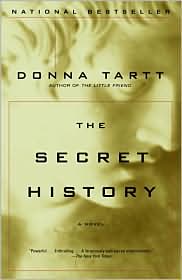
Donna Tartt's "The Secret History"

Read: July 22, 2011
NPR does this great segment where an author or somebody special will highlight three books that correspond to a special theme. On July 13th, the week after the release of the last Harry Potter movie, Annie Ropeik wrote "3 Grown-Up Books for the Hogwarts Grad". She listed Lev Grossman's The Magicians, Orson Scott Card's Ender's Game and Donna Tartt's The Secret History. Given how much I loved the first two, and how much I secretly hope to encounter again that enthusiastic reading experience I associate with Harry Potter, The Secret History jumped immediately to the very top of my to-read list.

Similar to Ender's Game, The Secret History is a book that seems incredibly challenging to describe - at least judging by the publisher's blurb on the back of the book. The novel follows protagonist Richard Papen who transfers from a community college in California to an elite private school Hampden in New England where he takes Greek. Studying Greek at Hampden means studying under Julian, an eccentric professor who demands complete control over his student's curriculum - every class they take is with him and he is incredibly picky about the students he accepts into this program. Richard, once he convinces Julian to take him on, joins a cohort of only six: erudite Henry, fashionable Francis, the twins Camilla and Charles, and loud and overtly friendly Bunny. From the prologue, Richard begins his story, "The snow in the mountains was melting and Bunny had been dead for several weeks before we came to understand the gravity of our situation....I suppose at one time in my life I might have had any number of stories, but now there is no other. this is the only story I will ever be able to tell."

The retrospective novel is the suspenseful lead-up to this moment of doomed realization. Despite the fact that you know from the beginning, and Richard frequently refers back to this knowledge, how the story will play out, you continually hope that the story will change, because who could things deteriorate to such a point. In the end, this remains my biggest problem with the story - how could this happen and be played off in such a cavalier way? Not to say that Tartt doesn't make the narrative entirely compelling. It's a smart read - begins with quotes from Nietzsche and Plato and is peppered with literary and classical allusions. I enjoyed feeling on the inside of this very smart circle of friends and reveling in their schoolwork (here I think is the closest comparison to Harry Potter), but at the same time, you wonder how these kids are maintaining this very challenging course load at the same time as all the drinking, drugs, and partying (not to mention murder). I think Tartt carefully balances the line between the scholasticism of her characters and their baser motivations, but she only barely manages to keep this line, which gives the narrative a slight feel of unbelievability.

With just a touch of a reader's suspension of disbelief, however, this book is a suspenseful and engrossing tale. If you can be just a little generous, I recommend it.

Elizabeth Strout's "Olive Kitteredge"

Read: July 22, 2011
I came across this book in this excellent bookstore in Wayland Square - the kind of bookstore that, instead of a table devoted entirely to tables with "As seen at the movies" or "Like Twilight? Try these!" themes has tables devoted to "Booker Prize nominees" or "Pulitzer Prize winners." The rare gem of a bookstore that is a real danger to the purse, because most on the shelves have books that you have been looking for or, and here's the danger, books that you desperately want to read and didn't even know you were searching for. Olive Kitteridge won the Pulitzer for fiction in 2009 and therefore resided in the Pulitzer Prize display at Books on the Square. That, combined with the fact that I had met Elizabeth Strout when she came to talk about Abide with Me to Mr. Bush's high school literary club, helped me overcome my general dislike of short story collections and compelled me to buy it.

It's taken me some time to get to this book review (about a month) because I am still uncertain about what I'd like to say. To start with, this is one of the most integrated short story collections I've encountered. The stories follow the lives of people in a small town in Maine, but the focal point is one of the residents, Olive Kitteridge, a retired schoolteacher. The stories jump around in time a little, but in general it follows Olive's later life. As a focal point, Olive is both engaging and problematic. In the stories that focus on her point of view, or her husband's, you see Olive as a somewhat bitter, often mean, woman who takes her husband for granted and coddles her adult son. When she interacts with the people in her town, however, she is perceptive and patient, helping them through their crises with a refreshing no-nonsense generosity. Strout's carefully constructed character seamlessly balances Olive's acerbity so that she's a character who, on one hand, can see through social niceties to a deeper truth of an interpersonal interaction while at the same time residing in blindness or outright denial about the people who are closest to her. Olive's husband, Henry, is a kindly pharmacist who always has a nice word for everybody, which irks Olive; his gentility seems at extreme odds to Olive's asperity.

The collection as a whole has an incredibly true-to-life mimetic quality. For me, the elements of postmodernism represented a challenge. There's no clear narrative arc, characters pass in and out of the tale, and to the end I can't decide whether I like Olive or not. As the incredibly well-rounded character that she is, though, I can only imagine her dismissing those kinds of thoughts, as if to say "What do I care whether you like me or not?"

Sunday, 24 July 2011

Rebecca Skloot's "The Immortal Life of Henrietta Lacks"

Read: July 15, 2011
Henrietta Lacks died of cervical cancer in 1951. She had gone to the clinic at Johns Hopkins because it was one of the few places in her area that would treat black people, in part because the charter for the hospital specifies this charitable duty and in part because they would conduct research on their poor (mostly black) patients. During a treatment procedure, her doctors removed swabs of cells – one of Henrietta’s normal cervical cells and another of her tumor. Despite treatment, the tumors overtook Henrietta’s body and she died quickly and painfully. Her cells, however, were given to George Gey’s lab, which had been attempting to produce a cell line that would self-replicate outside of the body. With Henrietta’s cancer cells, named HeLa for the first two letters of her first and last names, Gey had found the golden ticket: not only did HeLa self-replicate outside the body, they replicated at an abnormally fast pace. The HeLa cells would be used in all manner of scientific experiments: they journeyed into space, they’ve helped find the cure for polio. There are now more HeLa cells than there were ever cells in the original Henrietta Lacks. But up until relatively recently, her family had no idea that her cells had ever been extracted, multiplied, and achieved fame.
The Immortal Life of Henrietta Lacks is a rather personally-written nonfiction book. Rebecca Skloot approaches the subject from her own experience with HeLa cells and her curiosity about the woman behind them (alternately named Henrietta Lacks and Helen Larson). As such, the nonfiction book is an engrossing tale. Skloot intersperses chapters about Henrietta’s life and family with chapters about the history of the science behind HeLa cells. The science chapters are very accessible, in part because Skloot’s audience seems to have changed while she wrote the book. Originally interested in a kind of human-interest science story, Skloot discovers that the Lacks family is recalcitrant at best when it comes to talking about Henrietta. She must convince them that she is trustworthy, which she does by spending years consistently talking to Deborah and the other Lacks siblings and answering their questions about Henrietta’s life (to the best of her research abilities) and the life of her cells. Her interactions with the Lacks children, especially Deborah, transformed this book into a story about Deborah’s discovery of her mother and her acceptance of the fact that her mother’s cells had been taken without her permission or knowledge and made into a billion dollar industry.
Throughout the book, Skloot hints at this injustice without taking a stance either way. The Lacks sons are adamant that they are owed a large monetary settlement from the companies manufacturing HeLa cells. To this day, HeLa cells are still the longest-living cell line – they grow at such a pace as to infect, outstrip, and overtake other cell cultures in a lab. The original researcher, George Gey, did not patent any of his discoveries, sending out HeLa cells for free to further the research into the human body, but later entrepreneurs would make quite a profit from Henrietta. One of the most often quoted injustices is the fact that while the medical industry continues to make profits from HeLa, Henrietta’s descendants can often not afford medical insurance or expensive procedures. The book is written so empathetically that my first response is outrage at this injustice. On further reflection, however, I think that this line of argument mistakes one injustice for a social failing. It’s a problem if any family cannot keep health insurance and afford medical care, regardless of who their mother is. At the same time, I think there has been a great injustice done because of the way Henrietta’s doctors took advantage of her ignorance and the ignorance of her family members. Part of Skloot’s contribution was to explain, carefully and repeatedly, to Deborah and her brothers what the HeLa cells have been used for and what they have not done. Deborah was under the impression that because they had cloned a HeLa cell in London, a replica of her mother was walking along the Thames. Furthermore, possibly because of their fears of a lawsuit or something similar, JHU had been reluctant to acknowledge their indebtedness to Henrietta in some kind of tribute – be it statue, plaque, building name, etc. This is a true crime.
I will say that the book, despite its unusual style for nonfiction, is very well written and informative. Skloot doesn’t spend too much time mired in scientific description, interspersing the narrative with quite a bit of “human interest.” I think if I were hoping for a more intellectually-engaged scientific description of the history behind cell lines, I would be disappointed, but then the book wouldn’t be as accessible or popular. Perhaps the science-heavy book is what Skloot intended to write, but the tribute to Henrietta’s contribution that resulted is well worth the detour. My one small complaint is something I’ve had troubles with in other popular nonfiction (The Devil in the White City comes to mind) – the inclusion of specific details with no explanation of where that information came from. The most egregious example I remember in this book was the idea that Mary Kubicek, the assistant in Gey’s lab, was “eating a tuna-salad sandwich at a long stone culture bench that doubled as a break table” when they brought in the swabs from Henrietta’s cells. How in the world did Skloot know what Mary had for lunch one nondescript day sixty years ago? It’s easy to let this kind of thing go, though, and follow the mesmerizing narrative.

Angela Carter's "The Bloody Chamber"

Read: July 9, 2011

In the Disney version of Sleeping Beauty, the princess Aurora is cursed to prick her finger on a spinning wheel at age 16 and fall into a deep sleep for years until Prince Charming rescues her. In Charles Perreault’s version, a king finds the sleeping beauty and impregnates her (either waking her up first or not). Beauty raises her two children and meanwhile, the king’s queen discovers this liaison and asks her chef to cook the children in dishes and serve them to the king. The chef hides the children in his own house  and cooks a dish with pork instead. When the king discovers his wife’s treachery, he has her killed and Beauty and their two children come to live at the castle. Happily ever after, right?

In Angela Carter’s version of Sleeping Beauty, “The Lady of the House of Love,” Sleeping Beauty is a sleepless vampire, the last in a long line of vampires descending from the original Dracula. The nearby town is deserted after years of “hunting” has either killed or scared off all the inhabitants. The Countess spends her nights reading her Tarot cards, hoping for any prognostication other than Death when one day her cards turn up Love. A young soldier on leave is traveling Europe on his bike (“the bicycle is the product of pure reason applied ot motion”) when he comes across this picturesque village. The soldier is brave and almost foolishly courageous; he does not know how to shiver. His fate is to learn true fear in the trenches of Europe except for this brief detour: “This being, rooted in change and time, is about to collide with the timeless Gothic eternity of the vampires, for whom all is as it has always been and will be, whose cards always fall in the same pattern.”  The Countess’s modus operandi is to invite the guest to dinner, which is served in an empty hall, and then ask the guest to join her for coffee. She wears the only gown she owns, an ancient wedding dress spotted with blood, and she woos her guest before dining on him. When she was young, she could content herself by feeding on small rabbits, “But now she is a woman, she must have men.”Except this time, her Tarot cards have shown her an outcome that is not Death but Love and she is both bewildered and excited to meet this young soldier who does not know how to shiver. Though she does not want him to die, she has yet to see her story play out in any other way.

Carter’s The Bloody Chamber is a collection of short stories based off of the original fairy tale collections, mostly those collected by Perreault and the Grimm brothers. Carter displays a deep knowledge of these original tales, playing off of themes and references (the “does not know how to shiver” characteristic actually comes from another Grimm fairy tale). I read this book as a part of a free course offered this summer at my library. We read the original fairy tales alongside Carter’s versions and our very knowledgeable instructor pointed out the intricacies of Carter’s imagination. In addition to this careful weaving, however, Carter is a master of the language with descriptions that linger and imagery that can be both dreadful and beautiful. Perhaps most enjoyable is the feminist twist Carter gives to the tales. In the Bluebeard tale, for example, the new wife escapes her husband’s sadism and turns him out of the house. A very highly recommended read.

Thursday, 21 July 2011

Lawrence Friedman's "Law in America"


Read: July 2, 2011
I found this book in the Short History series tucked in a corner of a great used bookstore in Providence. It was something of an impulse pick-up, my thoughts going something like, "you're interested in this, but should a) probably learn to like American studies more in general and b) know more, and maybe even find out if you're less interested than a preparing law school applicant should be." That, and it was $5.

I've taken a couple of shallow-interest level introduction to law in America-type seminars, and attended a couple of discussions/lectures, so my knowledge on this topic should only be considered basic. I can't speak, therefore, to the book's comprehensiveness - I can't list topics it should have discussed or big important cases it omitted. I can say that, speaking as something of a novice, the book carefully maintained the balance between comprehensiveness and detail. Friedman opens with an anecdote from his teaching experience - at the start of every semester, he picks up the paper on his way to class and then he begins his lecture by picking random articles in this fresh-off-the-press newspaper and demonstrating what elements of law play into this or that story. The point being the obvious conclusion that law permeates all aspects of our lives, especially those aspects we consider newsworthy.

After this introduction, Friedman divides his task into broad-sweeping categories: law in the colonial period (probably my expected favorite); economy and the law in the 19th century; family, race, and the law; crime and punishment; the 20th century and the administrative-welfare state; and law in the 21st century. The chapters proceed topically but also chronologically, to a degree. The third chapter mostly focuses on the relationship between the law and the economy in the boom-and-bust of industrial development, but it also flashes forward to the 20th and the 21st centuries and how the law relates to the economy throughout American history.

I found Friedman's content to be well-chosen and well-explained. I didn't encounter any explanations of the legal history behind the current state of affairs (for example the state of prisons after the war on drugs) that was new or unexpected, but it was enlightening simply as a result of the careful way he introduced topics and connections between laws and their repercussions. My greatest complaint with Friedman is that he has appalling grammar - obsessively using semi-colons when they were unnecessary or leaving sentences as subordinate clauses when simple punctuation could have solved his dilemma. After a bit, I could ignore it and focus on the content, which was worth it.

Saturday, 9 July 2011

Paul Coehlo's "The Alchemist"

The Alchemist is one of those books that I glanced over repeatedly until I noticed that it seemed to be everywhere. One of my good friends read it last summer and would only say, "You should read it. I want to talk about it." Enigmatic... The copy I found at a secondhand bookstore came with an introduction from the author. In answering the question, "why are these books so popular," he writes, "All I know is that, like Santiago the shepherd boy, we all need to be aware of our personal calling. What is a personal calling? It is God's blessing, it is the path that God chose for you here on Earth. Whenever we do something that fills us with enthusiasm, we are following our legend." Most people, he argues, don't have the courage to confront our own dream, and he gives several reasons for this: we are told from childhood it is impossible, we are afraid of hurting those around us by abandoning everything in order to pursue our dream, we are afraid of the defeats we will face on the path (and the easiness of saying, 'oh well, I didn't really want it anyway'), and finally, "the fear of realizing the dream for which we fought all our lives". My friend said that she's encountered several people who cite this book as "life-changing," and I can only assume it's because of these "life lessons" in following your personal calling. While I enjoyed the book, I think I disagree with its base message.

The novel, if it is a novel, was originally written in Portuguese and published in 1988. It has since been translated into 56 languages and has sold more than twenty million copies (as of 2002). The narrative has the feel of a well-told myth, in part because it is the story of a long-ranging quest, and in part because the characters remain sketches while peripheral characters pass by quickly. Santiago, the shepherd, dreams of visiting the pyramids in Egypt, and the book is the story of how he fulfills this personal calling, the challenges and defeats he encounters along the way, how he overcomes disappointments, and how he prioritizes this personal calling above all else. A central belief in the book is that if you are putting everything into achieving your personal calling, "the universe" will help you. Some of this is mystical - when Santiago is captured by a band of soldiers in the Sahara, he is able to call on the wind and the sun to fool them into thinking he is some kind of magic man. Partly the "conspiring universe" exists in these kinds of natural personifications, but as the opening introduction hints, Coehlo also argues for a kind of luck that comes to those who fight for their personal callings. Santiago loses and recovers his personal fortune something like four times throughout the tale, through stupidity (how often can you be robbed blind?) and smarts (he proves to be a hand at several businesses - not at all incongruous...).

For me, the whole belief system seems inherently selfish. In particular, the second obstacle Coehlo mentions in his opening intro: love. He writes, "We know what we want to do, but are afraid of hurting those around us by abandoning everything in order to pursue our dream. We do not realize that love is just a further impetus, not something that will prevent us going forward. We do not realize that those who genuinely wish us well want us to be happy and are prepared to accompany us on that journey." Santiago meets his true love at an oasis in the middle of the Sahara desert. Fatima, as a woman of the desert, "knows that men have to go away in order to return. And she already has her treasure: it's you. Now she expects that you will find what it is you're looking for." Maybe it's the gendered construction of this - as a woman, all Fatima wants out of life is a good man, and she's more than willing to wait around until Santiago fulfills his personal calling. I agree with the alchemist, a somewhat mythical character who is very in touch with the Soul of the World and who serves as a guide for Santiago from the oasis to the pyramids. He says that if Santiago ignores this deep calling, he will eventually become unhappy and that the only way he can live happily is to fulfill this calling first before he settles down. However, almost no personal callings that I can think of are easily answerable/accomplishable in the space of a few years. In fact, Coehlo's last point acknowledges that personal callings are most likely to be lifelong pursuits. So, if you have to wait to love somebody and create a life with them until after you have fulfilled that calling, doesn't that mean a lifetime of waiting? And honestly speaking, how likely is that you'll either a) find a person who has met their calling (be it you, like Fatima, or an actual thoughtful personal calling, like any real woman *ahem*) and that that person will be willing to wait for you or that b) you'll fulfill your calling in a reasonable amount of time and settle down with said person only to.... live a life without purpose?

I think this is the crux of what I don't understand about Coehlo's mythology. One, what kind of person only has one personal calling in life? And who, once they have achieved that single calling, is happy to live a life of ignorant bliss in the solitary knowledge of this one lifetime accomplishment. Furthermore, and perhaps most importantly, who doesn't change over time? Unless you're a cardboard cutout, you're a dynamic person and your preferences will change as you grow and experience more. And so, it seems necessary that your personal calling(s) will change over time with you, and that they might even grow to accommodate people you love. Maybe I'm oversimplifying, but it seems to me this plan is ludicrous: 1. identify your personal calling (let's hope you didn't pick something too young, like "I want to meet Barney..."), 2. throw everything else out the window until you meet this personal calling, 3. live a happy, satisfied life without a replacement calling/desire/goal.

Despite all of that  negative reaction, I might still say read it. It certainly inspired a lot of thought for me, and after all, I want to talk about it :)

Jasper Fforde's "The Eyre Affair"

Fforde's Thursday Next series is another one of those that's been on my list for quite awhile. The front page quote on this first novel gushes, "Filled with clever wordplay, literary allusion, and bibliowit, The Eyre Affair  combines elements of Monty Python, Harry Potter, Stephen Hawking, and Buffy the Vampire Slayer. But its quirky charm is all its own." What's not to like, right? And it was a series, so what's not to like in multiple volumes, right? Well, meh.

I will say in its defense that I enjoyed the so-called bibliowit. Fforde imagines a world where books are the most important pop culture aspect of life, and perhaps even more important than we consider pop culture today. People get into riots over who wrote the Shakespeare plays and Baconians (people who argue it was Sir Francis Bacon) go door-to-door evangelizing. The England Fforde imagines is still embroiled in the Crimean war and almost resembles a happier version of 1984. A Special Operations Network was invented to handle "policing duties considered either too unusual or too specialized to be tackled by the regular force." The SpecOps, as it's called, ranges from the mundane Neighborly Disputes (SO-30) and going into Literary Detectives (SO-27) and Art Crime (SO-24). "Anything below SO-20 was restricted information, although it was common konwledge that the ChronoGuard was SO-12 and Antiterrorism SO-9." Time travel was relatively common. Thursday's father once belonged to the ChronoGuard until he went on the run, jumping through time to avoid being caught by his former comrades, popping in and out of Thursday's life. Thursday works as a LiteraTec in SO-27. Along with the cultural importance placed on litearture in this world, author's homes and museums become shrines, fraud is lucrative (and therefore requires extensive policing) and manuscripts become hot commodities.

The basic plot of this first novel revolves around the theft of the manuscript of Jane Eyre, a device that allows people to jump into books, and a terrorist who threatens to change the plotline of the novel (which, because it is the manuscript, will change all subsequent editions) if his self-aggrandizing requests are not met. In my experience, fantasy/sci-fi novels can be good for two reasons: a fascinating world  that is either complete (fantasy) or plausibly and interestingly explained (sci-fi); or engrossing characters who pull you in and make you disregard gaps in the imagined world. In my opinion, The Eyre Affair does not meet either of these options. It was a moderately enjoyable read, but the world was only gestured at (it might have suffered from too closely resembling the modern world, which left me wondering which things were different and which were the same, amplifying the gaps), and the characters were not engrossing. The romance was bare-bones and tacked on as an after thought, which made me wonder why it was included at all. Maybe an editor said, "Jasper, if you're going to have a female protagonist, she needs to have a love interest and end happily married," but in my opinion that only detracted from the novel in my opinion. It was a fine summer read, but I very much doubt I'll return to any of the rest of the series or recommend in the future.

Saturday, 2 July 2011

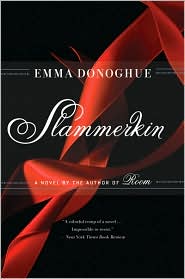
Emma Donoghue's "Slammerkin"

I have vague memories of Katherine reading Slammerkin in high school. She recommended it to me at the time, and I filed away that recommendation for later - whenever later arrived. Practically the second after finishing Room, I ordered Slammerkin. While waiting for it to arrive, I learned a little more about my new favorite author. Emma Donoghue was born in Ireland, spent several years living in England, and now lives in Canada. Her work is prolific and wide-ranging. I am actually very happy that I didn't learn too much more about Donoghue before reading Slammerkin. Room, I discovered, was actually rather unique within the Donoghue canon. She is most known for her historical fiction, but Donoghue has also written screenplays for both the stage and radio. She is also publishes works of literary criticism, including editing collections like Passions Between Women: British Lesbian Culture 1668-1801 and Inseparable: Desire Between Women in Literature. Much of her work, as is apparent from the titles, has lesbian undercurrents or themes. Though I have not read all of her works, I think this is one more thing that makes Room unique in her canon. It's also one of those obnoxiously definitive characteristics that you have to overcome as a reader. Things like Emily Dickinson's self-imposed isolation or Coleridge's melancholia. Episodes or characteristics of the author that become so critically important that they serve as a kind of shorthand for any analysis of the author's works. Good literary criticism, in my mind, has to overcome these preconceived prejudices before approaching any work.

All that being said, I knew next to nothing about Donoghue - that she has a PhD in literature from Cambridge, that she is both a lesbian and renowned for her lesbian fiction, or that she is well practiced at historical fiction (and respected for her thorough historical research) - before I opened Slammerkin. I consider this very fortunate. Slammerkin tells the story of Mary Saunders, a working-class girl in the mid-18th century London. Mary was fortunate enough to have a father who prioritized her education, so that even after he died, her mother continued to send her to a school for refinement. Mary's father died in the riots that swept London when England switched to the Gregorian calendar. Apparently the switch required a "jump" forward 11 days, and the working class men felt they had somehow been cheated out of 11 days wages. His death in these riots is sometimes treated with disdain (especially from his widow, who was disappointed in her dreams of becoming a famous London seamstress). It instilled in Mary, however, a desire for improving her status. She refused to be taught her mother's skills as a seamstress, instead vowing to herself that she would someday be one of the social elite who would buy the fancy gowns whom she sees on the streets One in particular catches her eye - a tall woman with a scarred face who has a beautiful red ribbon in her hair. Her desire for pretty things leads her to a ribbon seller who, when she asks for a red ribbon, rapes her and leaves her with a brown ribbon. When Mary turns up pregnant, her mother and stepfather kick her out on the streets.

Mary wanders for hours before falling down in a ditch, where she is raped repeatedly by a passing group of soldiers. The next morning, Doll, the woman with the scarred face, takes her under her wing. After Mary recovers from the clap in Doll's bed, Doll teaches her how to be a prostitute. A slammerkin, as Donoghue says in the opening quotation page, is a "noun, eighteenth century, of unkown origin. 1. A loose gown. 2. A loose woman." Mary's decline into London's underworld only amplifies  her fascination with beautiful things. Doll helps her buy the brightest slammerkins on the streets, "'A loose dress for a loose woman. Ever noticed the words for us all sound drunk?' Doll put on an intoxicated slur. 'Slovenly, slatternly sluts and slipshod, sleezy slammerkinds that we are!" On the streets, Mary learns the three all important rules: never give up your liberty; clothes make the woman; clothes are the greatest lie ever told.

When Mary gets on the wrong side of an enforcer, she flees London for her life, ending up in Monmouth where her mother had an old friend in the clothing business. She lies her way into an apprenticeship with this woman, telling her that her mother had died with a hope on her lips that Mary would learn the trade. The plot follows Mary's attempts to reform her life vying with the desire to be better, to improve her station. She craves the fine clothes she helps her mistress to make for the local elite, and this craving takes her down a very dark road.

Donoghue based the novel on an actual historical character, Mary Saunders, and she includes brief appearances from other real life characters. Though mostly fiction (very little is known for certain about Mary's sensational story), Donoghue's take on her psychology is fascinating. I will say that I think the reviews that talk about Mary's relationship with Doll as homoerotic have been very misdirected by knowledge of the author's own sexuality. Reading without this knowledge, I found nothing that gestured at all towards a sexual relationship between the two. They are very close, which given that they were all each other had and that they both felt responsible for the other seems like it should be a given. The relationship, at the very least, could be considered homosocial, but when talking about friendships in the 18th century, with the advent of sensibility, I'd wager most of the same-sex friendships would appear thus. At any rate, though, Slammerkin was a wonderful, highly recommended read.

Monday, 20 June 2011

Emma Donoghue's "Room"

Oh, where to even begin... I think I have told everybody who might be remotely interested to read this book. It's been on my list since it started racking up nominations and awards last year, and even with the hype, it still blew me away.

The premise of Room is simple: Jack and his Ma live in a 14x14 room, which is the entirety of Jack's universe. Jack and Ma live a highly routinized life: three meals each at 8ish, 12, and 5; one TV show a day (Jack loves Dora); exercise by running around Track; Shouting time, when they each take turns shouting at Skylight; building Snake (who lives under Bed) out of cracked eggshells; and each night Jack goes to sleep in Wardrobe and hopes that Old Nick won't come and visit Ma. Jack's voice is idiosyncratic and compelling; Donoghue claims the reader up until the very last page, which you both race towards and dread.

What makes this novel so fantastic is the subtle way Donoghue narrates the horrors of their life while maintaining Jack's perspective. One of  the more horrific scenes describes Jack counting the creaks of the bed from his hiding spot in the wardrobe while waiting for Old Nick to leave his Ma alone. On his fifth birthday, Ma decides he is old enough for the truth and so explains that there is a world outside of Room that is real, and that many things seen on TV are actually real. And soon, much too soon for young Jack, Ma begins planning their escape. Despite being told from an adoring son's point of view, Room presents Ma as a character with flaws of her own. She deals with serious depression and a guilt complex throughout the narrative, all of which is sketched on the sidelines of Jack discovering the truth about the world and his life.

Room is one of those books that is almost impossible to review fully without divulging all of the significant plot points; I personally think this is because the narrative, the ways Donoghue crafts her story, outshine the story, even such a tragic and compelling story as this. Read, read, read it.

Elizabeth Kostova's "The Swan Thieves"

When I saw that Elizabeth Kostova had a new book out, I was very excited. I had been swept up in the hype surrounding her debut novel, The Historian, which was a surprising retelling of the Dracula legend. Surprising, mostly, because it was not a book I would have anticipated liking nearly as much as I did - Kostova sweeps you up before you realize what's happening. I don't envy her having to follow up such a debut. I definitely think the international success of The Historian weighed on Kostova and her editors. The first time I picked up The Swan Thieves, I was repulsed by the overly large print. I think they wanted to plump up the book so it resembled the hefty weight and length of The Historian. I was not fooled - it felt like reading a Large Print book. So I decided to wait until the paperback came out - only to learn I'd waited for those months just so the editors/publishers could make the same stupid decision with the font size. Maybe others aren't bothered by this as I am, but it certainly downgraded my experience. (That, combined with a leaking water bottle and subsequent water damage led me to believe I should have opted for the ebook on this one).

The Swan Thieves opens with the renowned painter Robert Olivier taking out a knife and attacking an Impressionist painting in the National Gallery of Art. He is then referred to Andrew Marlow for psychiatric evaluation. He says, "I did it for her" before lapsing into a yearlong silence. Frustrated, Marlow breaks his own rules and probes into Olivier's private lives and personal relationships for answers. The book follows Marlow's investigations, with large sections devoted to the tales of Olivier's wife Kate and his young student/mistress Mary. A parallel storyline follows the letter exchanges between Beatrice de Clerval and her husband's uncle, who is both artistic mentor and romantic love interest to her.

One review I read compared the book to Dan Brown, by which I think it means to compare the elements of art-based mystery. Given my antipathy towards all things Dan Brown, I found this to be a disparaging comment that I don't think Kostova merits. The Swan Thieves is at its best in the lyric descriptions so utterly lacking in The Da Vinci Code (which the HuffPost review did mention as well). At the same time, it gets bogged down in plot. Kostova devotes large chunks of the novel to both Kate and Mary's perspectives, both of which I found to be drawn out and wordy. Kate's narrative, especially, seems to hint at some deep, dark secret about Robert which she seeks to keep, a dark secret never fully realized. (He certainly was not Dracula, to put it mildly, even though Kostova's use of delayed suspense echoed her earlier novel.) I found it incredibly difficult to motivate myself to get through the book, and though the last hundred or so pages were interesting, the art history mystery was not nearly enticing enough to merit the delays along the way, and the happy ending felt overly contrived (especially because the less-than-happy endings of other characters goes pretty much unmentioned).

I have recommended The Historian to several people over the years, but I will refrain (and perhaps even issue a warning against) The Swan Thieves. I enjoyed the parallel historical aspect and the novel had a lot of potential for a good smart-person's mystery, but it unfortunately did not live up to it.

Saturday, 7 May 2011

Sara Gruen’s “Water for Elephants”

Water for Elephants falls into that category of books with the special covers that attract my eye in bookstores. That, combined with the special promotions Barnes and Noble and other bookstores gave it as a New York Times bestseller, meant that it was one I noticed often. The subject matter, only vaguely described on the back of the book, of a depression-era circus was not a strong inducement however, so it remained on the bookstore shelves. I finally picked it up when I heard that there was a movie. Being the intellectual snob that I tend towards, I wanted to read it before everybody and their mother saw the movie, bought the movie-edition cover, and became huge fans. I guess this is the closest I can come to empathizing with diehard sports fans whose ire raises at fans who merely jump the bandwagon.
The novel operates as a series of flashbacks. Jacob Jankowski, is “ninety. Or ninety-three. One or the other.” He is a cranky old resident of a nursing home who has long since stopped keeping track of time: “What’s the difference between three weeks or three years or even three decades of mushy peas, tapioca, and Depends undergarments?” The arrival across the street of a circus interrupts his griping and plunges the reader into his own memories of his early life as a circus veterinarian. He was a student in his final year at Cornell’s veterinary school when both of his parents, his only family, die in a car accident. He is forced to sell his father’s practice to pay off he debts on the house and for his tuition and he is, suddenly, penniless, homeless, and friendless in the midst of the Depression. He jumps an unknown train in the night; the next morning, he discovers he has accidentally joined the circus. The novel progresses from there, intermittently returning to the nursing home where Jacob eagerly anticipates visiting the red top as he remembers his time in the circus as one of the best of his life.
I found the novel to be satisfactorily engaging: though not a page-turner, it did not drag. Jacob the curmudgeon was somewhat humorous, though often annoying, but Jacob the young vet was a good narrator. I don’t know that I found it nearly as “compelling…vivid…rich…emotional…riveting…[or] endlessly surprising” as the reviews on the back of the book found it to be. As a circus book, I would have thought the characters to be a little more interesting and well-developed. Jacob befriends a couple of outcasts, Walter (a midget known as Kinko with a beloved dog named Queenie) and Camel (the man who first introduced him to the ringmaster but who quickly succumbs to an alcohol-induced paralysis). Jacob must maneuver the sharp distinctions between the performers and the regular employees, though this initial trouble fades into the background as Jacob, the chief veterinarian, allies more closely with the performers. In general the book progresses like this – a problem is first introduced, be it the purchase of a new, seemingly-untrained elephant, the pain of Jacob’s unrequited love for the horsemistress Marlena (married to the ringmaster), the successful training of Rosie the elephant, or hiding Jacob and Marlena’s budding romance from gossipers and Marlena’s husband, or the escape of the circus menagerie and resultant stampede. Each problem is presented as a challenge, but then subtly fades into the background so that the resolution happens almost without notice.
I guess the reverse of this would be hyperdramatized narratives – and some of them (particularly the socially divided lunchroom and forbidden romance) are particularly stereotypical. So I suppose overly subtle is better than overly exaggerated. Certainly not the drama promised on the back cover. The resolution is neat and tidy, and pleasing in its happiness, though again Rosie’s part, so dramatically introduced in the prologue, reads almost like an afterthought. All in all, a pleasant read, with moderate spurts of excitement, but certainly not overwhelming. Maybe slightly recommended, though less than enthusiastically.

Saturday, 9 April 2011

Alan Bennett’s “The Uncommon Reader”

I can’t recall how I came across this short little novella. Somehow it made it onto my “to read” list on Goodreads, and when I needed a couple of extra dollars in my  B&N cart (to spend a Groupon… so many modern references!), I added it. How grateful I am for that impulsive decision!
In The Uncommon Reader, Alan Bennett imagines an alternate reality where Queen Elizabeth II stumbles across a traveling library, checks out a book to be polite, and reads it, because, “Once I start a book I finish it. That was the way one was brought up. Books, bread and butter, mashed potato – one finishes what’s on one’s plate. That’s always been my philosophy” (11). She had picked a book at random because she recognized the author as an acquaintance, and though she found it dull, she felt compelled out of politeness to check out another. Soon she’s hooked. She begins reading compulsively, even propping a book on her knees while she’s waving out her carriage. The formerly prompt queen begins running late and stops paying attention to her dress, to the point where her servants begin to worry that she’s developing Alzheimer’s. Her ministers attempt to hide her books and dismiss Norman, her friend and guide through literature, in the hopes that it will dissuade her from this new (and apparently dangerous) pastime.
The book is both a fun imagination of the Queen’s inner life and a mediation on the joys of reading. She beings writing down what she thinks about the books she reads and it’s a short step from this to writing about what happens to her in her life and what she thinks about the people she encounters. The surprise ending reads something like a drop off a cliff, but on contemplation, seems the perfect ending to this short little tale. Highly recommended!

Elizabeth Gilbert’s “Committed”

I read Eat, Pray, Love just when the dreaded movie cover edition (the concrete point when you know that you’re merely jumping on the bandwagon) came out, while I worked at CTY in Baltimore summer 2010. Betsy and Kelsey had both recommended it to me, but I have to confess the primary reason I succumbed to the hype and picked up the book at the JHU bookstore was that her new book, Committed, had been announced. Judging merely from the press releases, I though I would enjoy Committed, as a fellow skeptic of marriage, more than a book on sadness, pizza, and yoga. Eat, Pray, Love is a mediation on overcoming grief through introspection and moderated self-indulgence. Despite being increasingly more open to introspection and mediation in my life, I still found Gilbert’s first book to be overly sentimental and at times slow. I loved the middle section about prayer in a Buddhist temple, but the rest had its flaws.
The upshot of it all was that I waited six months before I bought Committed, and then in large part because I found it on sale. And then it took me a further two months before I read it. Life circumstances, however, encouraged me to pick it up. I have to confess, one of the things that attracted me the most to Committed was that Gilbert was an admitted skeptic about the institution. After her first divorce, she swears off marriage and all its potential disappointments. The source of the second book comes when her partner, Felipe, is deported because he does not have the proper visa to live in the United States. In order for them to live together in the States, they must acquire a fiancé visa and marry. While this is being processed, the two travel in southeast Asia while Gilbert obsesses over marriage.
I enjoyed Committed much more than Eat, Pray, Love, which I believe I can attribute to the comparatively small percentage of introspective/personal woe in favor of historical tales of marriage. Gilbert pulls these “asides,” as she calls them, both from personal encounters (including her own family history) as well as from “scholarly” sources. Gilbert forcibly claims at the opening of the book that she is not an anthropologist or an expert on marriage history, and recommends further reading for those who wish to find that kind of book. I think I appreciated what she said much more when she was talking about her mother’s or her grandmother’s experience, or even of the marriage customs of the local tribe she encounters on her travels, than I do when she talks about herself.
In the end, it was a good book to read for me at the time, but I don’t know how highly I would recommend it. It’s a very quick read and enjoyable for its ease, but it was also a shallow treatment.

Sunday, 27 March 2011

Cathleen Schine’s “The Three Weissmanns of Westport”

As a general rule, I’ve kept away from the countless Austen adapatations/homages/sequels/prequels that populate the bookstores, but when Cathleen Schine’s send-up of Austen’s Sense and Sensibility was listed as a New York Times Book Review notable book of the year, I decided to give it a try, and I’m very glad I did.
One of the problems I have with Austen interpretations is that so often authors use Austen’s plot lines or characters as an excuse to keep from inventing new material, and hten they so rarely stay true to the characters anyways. Elizabeth from Pride and Prejudice will become a murder mystery fanatic worthy of Agatha Christie or a Nancy Drew novel, or the book will stand as a shallow front for a Regency-era romance novel with much more sex than I expect Austen ever encountered. Schine, however, opted for a modernization of the novel with some very interesting twists. Instead of a dead father, the novel opens with the news of the impending divorce of Betty Weissmann and Joe, her husband of forty-eight years. The husband has met a new, younger woman who plays the part of Austen’s step-sister-in-law (I guess I should reread S&S as my grasp on names is appalling) by urging Joe to “be generous” and not leave such a large West Side apartment for the aging Betty to take care of. As a result, Betty moves to her cousin’s loaned cottage in Westport, joined by her two daughters. Miranda is a literary agent who publishes memoirs and has recently been caught in a series of scandals reminiscent of A Million Little Pieces. Annie is the level-headed library director who feels compelled to join her scatterbrained sister and shocked mother to help them manage their finances. The references to Austen are subtle and devoted, but with more than enough modern dialogue and cultural analysis to make this book more than interesting to stand alone.
One reason I think I found this adaptation to be so relevant was its treatment of divorce. One particularly poignant observation comes from Anne, “She almost wished he had died, she realized with shame, for then she would have been able to remember him as he had been, distant but in a quiet, patient, and reassuring way, someone she admired and looked up to and relied on. Instead, he was a living, unreliable, despicable deserter” (Schine 65).
Finally, the novel impressed me by not relying on Austen for the ending, which would have been trite and (especially according to modern standards) implausible. I’ve always felt that Sense and Sensibility is Austen’s most depressing novel – poor Marianne gets a very half-hearted ending. Schine doesn’t bother with remaining true to the letter of Austen. Annie (Elinor) ends up with the Colonel Bradford figure (as the Hugh Grant figure proves less than worthy – accidentally knocking up a young girl is not quite the same as remaining true to a marriage promise made as a youth) and Miranda (Marianne) ends up with the ex-wife of the man who jilted her for a younger woman. An unexpected and more than satisfying end! I think I liked this book because I was ready for something light, but also because she treats Austen with respect without veering towards either extreme of abject obligation or character/plot abuse.

Erik Larson's "The Devil in the White City"

At its best, Erik Larson's The Devil in the White City is an immensely pleasurable recount of the World's Fair in Chicago at the end of the 19th century. Janet Maslin, in a review of the book for the New York Times, commented, "A dynamic, enveloping book... Relentlessly fuses history and entertainment to give this nonfiction book the dramatic effect of a novel... It doesn't hurt that this truth is stranger than fiction." I have to agree with this high commendation. Rarely have I come across a more engrossing nonfiction book.

The Devil in the White City pulls together two stories centered around the fulcrum point of the World's Fair in Chicago, 1893. Larson presents two men as counterparts: the ambitious, talented architect and designer of the fair, Daniel Burnham; and the dangerous psychopath Dr. H. H. Holmes. When Chicago beats out New York and other American cities as the chosen city for the fair, Burnham and his partner John Root are elected as the team of architects to serve as directors of works. Holmes, living in Chicago at the time, quickly built a hotel to house young, female visitors to the fair. His self-designed hotel came complete with an oven large enough to fit a person and a sound-proof room. He hides these incriminating details by hiring poor day laborers and firing them constantly to rehire more poor laborers unfamiliar with the project. The book does a good job of bouncing back and forth between the stories. I don’t recall every feeling fed up with one storyline before Larson would shift the focus. I have to admit, however, that I thought the stories would collide or intermingle at the climax. There was a brief point of commingling when Holmes took one of his many wives (he was quite the bigamist) and her sister to the fair, but in general the stories remained separate.

Larson did attempt to tie them together thematically, and therein lies his true strength as an historian. I spoke to my hairdresser about the book (yes, mock away), and he said that despite several attempts (motivated because he was an architect in Chicago before moving to Providence and becoming a hairdresser), he could never make it past all the dull history in the beginning. Apparently some of his friends told him, just get past the first bit, it gets better. I have to admit I found the opposite to be true. Larson has a fantastic grip on the Gilded Age in Chicago – I love the menus for the fancy dinners the architects and sponsors held, the rather indelible image of the Chicagoans gathered around the telegraph office waiting for news from Congress on who would host the World’s Fair, or the clash of personalities in the early design stages of the fair. Larson certainly did his homework and it’s very clear in this early section. My one objection is that I wish he had provided more excerpts from the journals or newspaper stories where he got his information. In this, The Devil in the White City certainly suffers the stigma of being “popular history” – there are few requirements for quotations or citations, and this becomes more apparent farther into the book, especially in the Holmes sections. I found myself thinking more than once, “how can you possibly know he felt that?” Or, even worse, “how do you know he did this or went to this fair?” It would have been fascinating to read some of these descriptions from Holmes’s own words. Later, Larson tells us that Homes wrote a biography/defense of his life, and I presume this is where Larson gets a lot of his information, but provides very little for his reader.

I read one review of the book that mocked it by saying it was a book Larson wanted to write about the history of the world’s fair, with some psychopath murderer plot line thrown in for interest’s sake, and I find this to be a somewhat damning comment. Though I think the mixing of the two stories works out moderately well, the end of the book certainly demonstrates the problems. I was disappointed to find that the stories wouldn’t merge – Holmes and Burnham never met, for example. And the fair was over long before Holmes was caught, so his crimes didn’t taint Chicago or the World’s Fair in the way I had been expecting. I feel that the book would have benefited from some rather extensive editing – it ran too long; I had trouble convincing myself to finish it. Holmes’s plot line extends far past Burnham’s last narrative appearance, including the introduction of an entirely brand new character (the dectective who caught Holmes - as a side note, I was disturbed/fascinated at the extremely poor quality of the police in the midst of the Holmes murders...) that I think should have appeared sooner – new characters in the final chapters feels too much like a real life deus ex machina. The novel also opens with a flashback scene with Burnham on the Olympic when he receives news of the sinking of the Titanic along with his friend from the World Fair days, Millet. I found this prologue to be entirely unnecessary and something of a distraction, especially as it was only loosely returned to in the conclusion (perhaps as a way of bringing up Burnham again long after his story finished?)

Despite these objections, the book was for the most part a very interesting read. I have heard rumors that there will be a movie adaptation soon, though I’m skeptical as to how well the screenwriter/adapter will keep to historical fact as presented in the novel. I get the feeling that Larson manipulated facts/details to suit his narrative, so one can only imagine how far the movie will depart from even his minor adjustments. 

Friday, 25 February 2011

Tom Rachman's "The Imperfectionists"

    As a general rule, I find it easier to write scathing/critical reviews of books than to write positive ones. I think this is probably true of all critics, at the very least because criticisms seem much more thoughtful and thought-provoking than simple endorsement. That being said, this review will be difficult (perhaps why it's been delayed) because I loved The Imperfectionists.

I encountered the book on one of those Best of the Year lists for 2010 (and then conveniently looked for it in a bookstore right around the time it came out in paperback). The review I read didn't mention, or I didn't realize, that it was actually a collection of interrelated short stories. I think it's probably for the best that I didn't know this beforehand, or I would have been prejudiced against it. More often than not, I find short stories slightly melodramatic - trying to pack a punch into a short space. This is compounded by short story collections - it's the length of a book, but it's just fifteen-odd  punches to the tear ducts. This was not the case with The Imperfectionists (see how I write positive things by denouncing criticisms? Cheap shot).

The collection follows an international English newspaper based in Rome. Each of the stories follows one of the contributors to the newspaper (field writers, editors, accounting, copy writers, owner, reader, etc) and the stories are interspersed by short vignettes that follow the start of the newspaper. Rachman's gift is to make each of his characters so vibrantly alive that when they pop up in each other's stories, you feel like you're encountering somebody you know intimately. The challenging part of reading their stories is that Rachman makes you feel connected to them, sharing their hopes and dreams, so that when something goes wrong or (more mundanely) the hope doesn't materialize, you feel let down. For me, this meant I often needed to pause after reading each story before starting the next one - not just to get out of one character's head but to adjust to the disappointment I shared almost viscerally with these fictional characters.

As the stories progress, Rachman slowly develops the decay of the newspaper. The first story follows Lloyd Burko, a field writer stationed in Paris, which I thought was a really good way to begin. Lloyd's personal life is crumbling as his third (and much younger) wife slowly leaves him for the man across the hall and so he finds his professional work that much more difficult. In Lloyd's story, the newspaper in Rome comes off as a solid institution. Towards the end of the book, however, we encounter reader Ornella de Monterecchi  who has collected every paper published for some twenty years and is slowly reading every article (she is currently maybe fifteen years behind present day). I found Ornella's story an interesting look at the problems facing the newspaper industry - by the time the paper makes it to the stands in the morning, all of yesterday's news is incredibly old and so the papers are only worthwhile to people like Ornella living in the past.

All in all, as I promised, a weak review to balance out a wonderful book.

Wednesday, 2 February 2011

Simon Winchester's The Professor and the Madman

I have to admit I was not entirely well-pleased with Simon Winchester's The Professor and the Madman. For all the intrigue of the title and subtitle (A Tale of Murder, Insanity, and the Making of the Oxford English Dictionary), the book suffered from a seemingly haphazard structure and severely tapering plot.

That being said, I did find the subject matter very interesting. Winchester follows the creation of the Oxford English Dictionary and the life story of one of the most influential volunteers, Dr. W C Minor. Minor was a doctor in the Union army during the American Civil War, during which he probably suffered a shock that sent him spiraling into what Winchester diagnoses as paranoid schizophrenia. As an army pensioner, however, he receives the best care and even is granted a release from the hospital. He travels to London to recuperate, but while living there convinces himself that people are trying to break into his room at night and then murders a man on the street. Minor is lucky enough to be tried during a period of leniency in Victorian judicial proceedings and the court finds him not guilty on the basis of insanity. He is sentenced to a mental hospital to 'await the Queen's pleasure.' Minor remains there for much of the rest of his life. The pinnacle of his imprisoned life is his participation in the making of the Oxford English Dictionary.

A nonfiction text like this one necessarily faces the difficult challenge of connecting several strands of narrative together into a cohesive whole. Winchester does an excellent job at making those strands into very interesting vignettes. He writes on the history of dictionary making, which the English student in me particularly liked. He also writes on what Minor would have encountered as an army doctor in the American Civil War, the life story of James Murray, the chief editor of the OED, and various diagnoses in the history of schizophrenia.

By far the most interesting part of the book is the bit on the interaction between Minor and Murray. Murray and his team put out advertisements to call for volunteers. The goal of the OED, to catalogue every word in the English language along with several quotes to demonstrate each use of the word and, most importantly, to discover the earliest known use of the word, was a task of such immensity it could never have been completed without an equally immense workforce. To this end, the OED editor asked for volunteers to read books in certain time periods and submit words, along with quotations, they thought might be interesting. Murray's team then collected these thousands and thousands of slips of paper, filed them alphabetically, and proceeded to start with the letter A. Minor, on the other hand, knew he was in a unique position. As a hospital inmate, he would be able to devote all of his time and all of the library he had been accumulating. So instead of sending words he found in books, he cataloged all words and corresponding page numbers in all of his books. He then inquired of Murray where in the alphabet his team was working and if they were having trouble finding quotations or instances of specific words. When Murray responded, he would references his catalogs, pull the books off his shelf and send in quotations. In this way, he could fill the gaps that the varied and easily distracted volunteer team left behind. Though Minor would not submit the most words of any OED volunteer, his contributions appear in the text more than any other contributor because he sent in what was needed at the moment.

This part of the story was engrossing and detailed. However, the layout of the text did not seem optimal to me. The book began with a description of Murray going to visit his most valuable volunteer at the address on the letters he had been receiving for ten years. Murray is surprised to find out, however, that Dr. W C Minor is not the resident doctor at the mental institution, but rather one of its oldest residents. Catchy opening, yes? In fact, this tale is an overly romanticized one - Murray had known Minor was an inmate at the asylum for several years prior to meeting him in person. Winchester plays this detail like a surprising twist - you thought you knew how Murray and Minor met, but in fact it was much less interesting! It's a twist that only confuses the reader (wait, I thought the book opened, 150 pages ago, on a scene of Murray walking up to the asylum?), who presumably is not familiar with the romanticized version of the tale.

Once Winchester unwraps this surprising twist, the novel peters out. He goes on to describe how Minor succumbs to his own disease, committing a pretty gruesome act of self-mutilation and returns to an asylum near his brother in the United States. Murray's death is glossed over. Winchester muses on the history of schizophrenia paranoia and concludes with a brief passage on the completion of the OED.

The Professor and the Madman was at times interesting and informative, but perhaps geared to a shorter, more concise medium. As a whole, I found the tangents far too tangential and the narrative lacking in cohesion.