 |
| Read: July 22, 2011 |
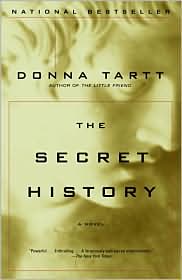
Similar to Ender's Game, The Secret History is a book that seems incredibly challenging to describe - at least judging by the publisher's blurb on the back of the book. The novel follows protagonist Richard Papen who transfers from a community college in California to an elite private school Hampden in New England where he takes Greek. Studying Greek at Hampden means studying under Julian, an eccentric professor who demands complete control over his student's curriculum - every class they take is with him and he is incredibly picky about the students he accepts into this program. Richard, once he convinces Julian to take him on, joins a cohort of only six: erudite Henry, fashionable Francis, the twins Camilla and Charles, and loud and overtly friendly Bunny. From the prologue, Richard begins his story, "The snow in the mountains was melting and Bunny had been dead for several weeks before we came to understand the gravity of our situation....I suppose at one time in my life I might have had any number of stories, but now there is no other. this is the only story I will ever be able to tell."
The retrospective novel is the suspenseful lead-up to this moment of doomed realization. Despite the fact that you know from the beginning, and Richard frequently refers back to this knowledge, how the story will play out, you continually hope that the story will change, because who could things deteriorate to such a point. In the end, this remains my biggest problem with the story - how could this happen and be played off in such a cavalier way? Not to say that Tartt doesn't make the narrative entirely compelling. It's a smart read - begins with quotes from Nietzsche and Plato and is peppered with literary and classical allusions. I enjoyed feeling on the inside of this very smart circle of friends and reveling in their schoolwork (here I think is the closest comparison to Harry Potter), but at the same time, you wonder how these kids are maintaining this very challenging course load at the same time as all the drinking, drugs, and partying (not to mention murder). I think Tartt carefully balances the line between the scholasticism of her characters and their baser motivations, but she only barely manages to keep this line, which gives the narrative a slight feel of unbelievability.
With just a touch of a reader's suspension of disbelief, however, this book is a suspenseful and engrossing tale. If you can be just a little generous, I recommend it.


No comments:
Post a Comment