 |
| Read: December 19, 2011 |
As a book from the magical realism genre (think The Time Traveler's Wife or One Hundred Years of Solitude), it's difficult to describe the plot. So much of these books necessarily require world building - some explanation of how the magical elements function. In The Night Circus, magic is a real, though mostly secret, force in the world, accessible to those with an aptitude, either innate or self-taught. There are two competing schools of magic: one, held by Prospero (stage name), argues that magic is a skill a person is born with and which practice can improve and perfect; another, held by the man in the grey suit (unnamed), believes that magic is based on theory which can be taught and a deeper understanding of these theories and ideas will make a stronger practice. These two competing schools, if you will, have in the past bound their students in competition with each other to discover which of the two is the stronger, and by extension, posits the true understanding of magic.
As children, Marco and Celia are bound to each other as competitors, though they are told almost nothing about this binding or the details of the competition. Prospero proposes the competition and thus chooses the location of the competition in a magical circus. Thus, Les Cirque du Reves is born - a beautiful circus completely decorated in black and white, consisting of multiple tents with a wide variety of magical and seemingly magical exhibits, and one which takes place only at nighttime. As Prospero's student, Celia is the circus's illusionist, who hides her magical abilities in what seem to be almost impossible stage tricks. Marco, her opponent, begins as a consultant for the circus's designer, influencing the circus from afar. In this magical world, Celia and Marco stage increasingly impressive displays of magic, discovering each other in the process, and the awful truth that this competition to which they have been bound is one in which there is only one winner, one survivor.
The story is told through a few interrelated plot lines. One, perhaps the most unique, describes the experience of a circus attender in second person. The book begins, "The circus arrives without warning...yet as dusk approaches there is a substantial crowd of spectators gathering outside the gates. You are amongst them, of course. Your curiosity got the better of you, as curiosity is wont to do. You stand in the fading light, the scarf around your neck pulled up against the chilly evening breeze, waiting to see for yourself exactly what kind of circus only opens once the sun sets." What a hook! This opening chapter quickly establishes the aura of magic and mystery that permeates the novel, as well as the unique methods Morgenstern will employ to tell her tale. The plot also progresses with quotes pulled from "books" written by Frederick Thiessen, an expert and primary fan of The Night Circus. Morgenstern tells the story of Marco and Celia's separate childhoods, magical training, and how they become involved in The Night Circus. Finally, the novel narrates a "contemporary," that is a plot line that occurs concurrently with the climax of Marco and Celia's plot line, story of a young farm boy who falls in love with the circus. These last two plot lines require the reader to pay attention to the dates at the top of the chapters in order to keep events in chronological order, though this does not detract from the overall effect.
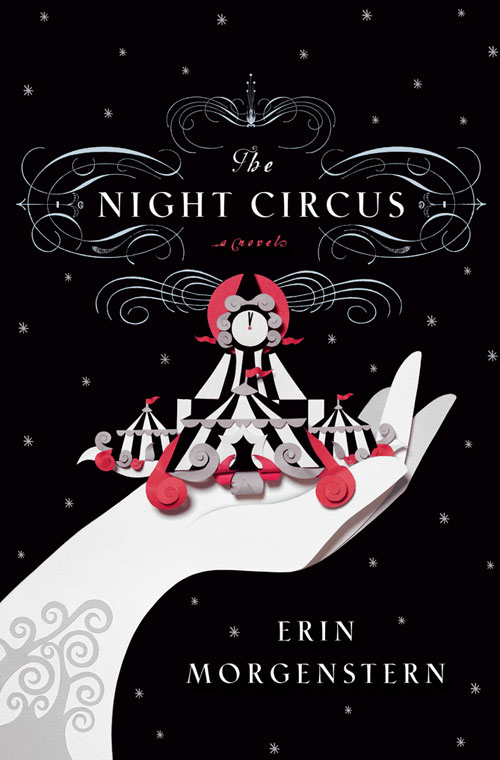
I would highly recommend this book to anybody who is interested in magical realism, who wants to fall into a book and learn the rules of the world its creating, and who yearns for that depressing pleasure of missing the characters and the world once the last page is turned. I also advise that people read this book in paper form. Ironically, I believe, this book is impeccably designed and detailed in a way that would not be possible to read in ebook form, but which also would not have been possible to publish were it not for the threat of ebooks to publishers. Several news stories lately have talked about how publishers are now taking two approaches to publishing: a quick and easy ebook for the pulp fiction and a beautifully designed and wrapped book for the kind of book people want to treasure on their shelves. Seems to match my style of reading! This book is definitely part of the latter group - buy it in hardback/paperback!

