Sunday, 14 August 2011

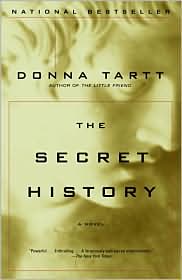
Donna Tartt's "The Secret History"

Read: July 22, 2011
NPR does this great segment where an author or somebody special will highlight three books that correspond to a special theme. On July 13th, the week after the release of the last Harry Potter movie, Annie Ropeik wrote "3 Grown-Up Books for the Hogwarts Grad". She listed Lev Grossman's The Magicians, Orson Scott Card's Ender's Game and Donna Tartt's The Secret History. Given how much I loved the first two, and how much I secretly hope to encounter again that enthusiastic reading experience I associate with Harry Potter, The Secret History jumped immediately to the very top of my to-read list.

Similar to Ender's Game, The Secret History is a book that seems incredibly challenging to describe - at least judging by the publisher's blurb on the back of the book. The novel follows protagonist Richard Papen who transfers from a community college in California to an elite private school Hampden in New England where he takes Greek. Studying Greek at Hampden means studying under Julian, an eccentric professor who demands complete control over his student's curriculum - every class they take is with him and he is incredibly picky about the students he accepts into this program. Richard, once he convinces Julian to take him on, joins a cohort of only six: erudite Henry, fashionable Francis, the twins Camilla and Charles, and loud and overtly friendly Bunny. From the prologue, Richard begins his story, "The snow in the mountains was melting and Bunny had been dead for several weeks before we came to understand the gravity of our situation....I suppose at one time in my life I might have had any number of stories, but now there is no other. this is the only story I will ever be able to tell."

The retrospective novel is the suspenseful lead-up to this moment of doomed realization. Despite the fact that you know from the beginning, and Richard frequently refers back to this knowledge, how the story will play out, you continually hope that the story will change, because who could things deteriorate to such a point. In the end, this remains my biggest problem with the story - how could this happen and be played off in such a cavalier way? Not to say that Tartt doesn't make the narrative entirely compelling. It's a smart read - begins with quotes from Nietzsche and Plato and is peppered with literary and classical allusions. I enjoyed feeling on the inside of this very smart circle of friends and reveling in their schoolwork (here I think is the closest comparison to Harry Potter), but at the same time, you wonder how these kids are maintaining this very challenging course load at the same time as all the drinking, drugs, and partying (not to mention murder). I think Tartt carefully balances the line between the scholasticism of her characters and their baser motivations, but she only barely manages to keep this line, which gives the narrative a slight feel of unbelievability.

With just a touch of a reader's suspension of disbelief, however, this book is a suspenseful and engrossing tale. If you can be just a little generous, I recommend it.

Elizabeth Strout's "Olive Kitteredge"

Read: July 22, 2011
I came across this book in this excellent bookstore in Wayland Square - the kind of bookstore that, instead of a table devoted entirely to tables with "As seen at the movies" or "Like Twilight? Try these!" themes has tables devoted to "Booker Prize nominees" or "Pulitzer Prize winners." The rare gem of a bookstore that is a real danger to the purse, because most on the shelves have books that you have been looking for or, and here's the danger, books that you desperately want to read and didn't even know you were searching for. Olive Kitteridge won the Pulitzer for fiction in 2009 and therefore resided in the Pulitzer Prize display at Books on the Square. That, combined with the fact that I had met Elizabeth Strout when she came to talk about Abide with Me to Mr. Bush's high school literary club, helped me overcome my general dislike of short story collections and compelled me to buy it.

It's taken me some time to get to this book review (about a month) because I am still uncertain about what I'd like to say. To start with, this is one of the most integrated short story collections I've encountered. The stories follow the lives of people in a small town in Maine, but the focal point is one of the residents, Olive Kitteridge, a retired schoolteacher. The stories jump around in time a little, but in general it follows Olive's later life. As a focal point, Olive is both engaging and problematic. In the stories that focus on her point of view, or her husband's, you see Olive as a somewhat bitter, often mean, woman who takes her husband for granted and coddles her adult son. When she interacts with the people in her town, however, she is perceptive and patient, helping them through their crises with a refreshing no-nonsense generosity. Strout's carefully constructed character seamlessly balances Olive's acerbity so that she's a character who, on one hand, can see through social niceties to a deeper truth of an interpersonal interaction while at the same time residing in blindness or outright denial about the people who are closest to her. Olive's husband, Henry, is a kindly pharmacist who always has a nice word for everybody, which irks Olive; his gentility seems at extreme odds to Olive's asperity.

The collection as a whole has an incredibly true-to-life mimetic quality. For me, the elements of postmodernism represented a challenge. There's no clear narrative arc, characters pass in and out of the tale, and to the end I can't decide whether I like Olive or not. As the incredibly well-rounded character that she is, though, I can only imagine her dismissing those kinds of thoughts, as if to say "What do I care whether you like me or not?"