Sunday, 24 July 2011

Rebecca Skloot's "The Immortal Life of Henrietta Lacks"

Read: July 15, 2011
Henrietta Lacks died of cervical cancer in 1951. She had gone to the clinic at Johns Hopkins because it was one of the few places in her area that would treat black people, in part because the charter for the hospital specifies this charitable duty and in part because they would conduct research on their poor (mostly black) patients. During a treatment procedure, her doctors removed swabs of cells – one of Henrietta’s normal cervical cells and another of her tumor. Despite treatment, the tumors overtook Henrietta’s body and she died quickly and painfully. Her cells, however, were given to George Gey’s lab, which had been attempting to produce a cell line that would self-replicate outside of the body. With Henrietta’s cancer cells, named HeLa for the first two letters of her first and last names, Gey had found the golden ticket: not only did HeLa self-replicate outside the body, they replicated at an abnormally fast pace. The HeLa cells would be used in all manner of scientific experiments: they journeyed into space, they’ve helped find the cure for polio. There are now more HeLa cells than there were ever cells in the original Henrietta Lacks. But up until relatively recently, her family had no idea that her cells had ever been extracted, multiplied, and achieved fame.
The Immortal Life of Henrietta Lacks is a rather personally-written nonfiction book. Rebecca Skloot approaches the subject from her own experience with HeLa cells and her curiosity about the woman behind them (alternately named Henrietta Lacks and Helen Larson). As such, the nonfiction book is an engrossing tale. Skloot intersperses chapters about Henrietta’s life and family with chapters about the history of the science behind HeLa cells. The science chapters are very accessible, in part because Skloot’s audience seems to have changed while she wrote the book. Originally interested in a kind of human-interest science story, Skloot discovers that the Lacks family is recalcitrant at best when it comes to talking about Henrietta. She must convince them that she is trustworthy, which she does by spending years consistently talking to Deborah and the other Lacks siblings and answering their questions about Henrietta’s life (to the best of her research abilities) and the life of her cells. Her interactions with the Lacks children, especially Deborah, transformed this book into a story about Deborah’s discovery of her mother and her acceptance of the fact that her mother’s cells had been taken without her permission or knowledge and made into a billion dollar industry.
Throughout the book, Skloot hints at this injustice without taking a stance either way. The Lacks sons are adamant that they are owed a large monetary settlement from the companies manufacturing HeLa cells. To this day, HeLa cells are still the longest-living cell line – they grow at such a pace as to infect, outstrip, and overtake other cell cultures in a lab. The original researcher, George Gey, did not patent any of his discoveries, sending out HeLa cells for free to further the research into the human body, but later entrepreneurs would make quite a profit from Henrietta. One of the most often quoted injustices is the fact that while the medical industry continues to make profits from HeLa, Henrietta’s descendants can often not afford medical insurance or expensive procedures. The book is written so empathetically that my first response is outrage at this injustice. On further reflection, however, I think that this line of argument mistakes one injustice for a social failing. It’s a problem if any family cannot keep health insurance and afford medical care, regardless of who their mother is. At the same time, I think there has been a great injustice done because of the way Henrietta’s doctors took advantage of her ignorance and the ignorance of her family members. Part of Skloot’s contribution was to explain, carefully and repeatedly, to Deborah and her brothers what the HeLa cells have been used for and what they have not done. Deborah was under the impression that because they had cloned a HeLa cell in London, a replica of her mother was walking along the Thames. Furthermore, possibly because of their fears of a lawsuit or something similar, JHU had been reluctant to acknowledge their indebtedness to Henrietta in some kind of tribute – be it statue, plaque, building name, etc. This is a true crime.
I will say that the book, despite its unusual style for nonfiction, is very well written and informative. Skloot doesn’t spend too much time mired in scientific description, interspersing the narrative with quite a bit of “human interest.” I think if I were hoping for a more intellectually-engaged scientific description of the history behind cell lines, I would be disappointed, but then the book wouldn’t be as accessible or popular. Perhaps the science-heavy book is what Skloot intended to write, but the tribute to Henrietta’s contribution that resulted is well worth the detour. My one small complaint is something I’ve had troubles with in other popular nonfiction (The Devil in the White City comes to mind) – the inclusion of specific details with no explanation of where that information came from. The most egregious example I remember in this book was the idea that Mary Kubicek, the assistant in Gey’s lab, was “eating a tuna-salad sandwich at a long stone culture bench that doubled as a break table” when they brought in the swabs from Henrietta’s cells. How in the world did Skloot know what Mary had for lunch one nondescript day sixty years ago? It’s easy to let this kind of thing go, though, and follow the mesmerizing narrative.

Angela Carter's "The Bloody Chamber"

Read: July 9, 2011

In the Disney version of Sleeping Beauty, the princess Aurora is cursed to prick her finger on a spinning wheel at age 16 and fall into a deep sleep for years until Prince Charming rescues her. In Charles Perreault’s version, a king finds the sleeping beauty and impregnates her (either waking her up first or not). Beauty raises her two children and meanwhile, the king’s queen discovers this liaison and asks her chef to cook the children in dishes and serve them to the king. The chef hides the children in his own house  and cooks a dish with pork instead. When the king discovers his wife’s treachery, he has her killed and Beauty and their two children come to live at the castle. Happily ever after, right?

In Angela Carter’s version of Sleeping Beauty, “The Lady of the House of Love,” Sleeping Beauty is a sleepless vampire, the last in a long line of vampires descending from the original Dracula. The nearby town is deserted after years of “hunting” has either killed or scared off all the inhabitants. The Countess spends her nights reading her Tarot cards, hoping for any prognostication other than Death when one day her cards turn up Love. A young soldier on leave is traveling Europe on his bike (“the bicycle is the product of pure reason applied ot motion”) when he comes across this picturesque village. The soldier is brave and almost foolishly courageous; he does not know how to shiver. His fate is to learn true fear in the trenches of Europe except for this brief detour: “This being, rooted in change and time, is about to collide with the timeless Gothic eternity of the vampires, for whom all is as it has always been and will be, whose cards always fall in the same pattern.”  The Countess’s modus operandi is to invite the guest to dinner, which is served in an empty hall, and then ask the guest to join her for coffee. She wears the only gown she owns, an ancient wedding dress spotted with blood, and she woos her guest before dining on him. When she was young, she could content herself by feeding on small rabbits, “But now she is a woman, she must have men.”Except this time, her Tarot cards have shown her an outcome that is not Death but Love and she is both bewildered and excited to meet this young soldier who does not know how to shiver. Though she does not want him to die, she has yet to see her story play out in any other way.

Carter’s The Bloody Chamber is a collection of short stories based off of the original fairy tale collections, mostly those collected by Perreault and the Grimm brothers. Carter displays a deep knowledge of these original tales, playing off of themes and references (the “does not know how to shiver” characteristic actually comes from another Grimm fairy tale). I read this book as a part of a free course offered this summer at my library. We read the original fairy tales alongside Carter’s versions and our very knowledgeable instructor pointed out the intricacies of Carter’s imagination. In addition to this careful weaving, however, Carter is a master of the language with descriptions that linger and imagery that can be both dreadful and beautiful. Perhaps most enjoyable is the feminist twist Carter gives to the tales. In the Bluebeard tale, for example, the new wife escapes her husband’s sadism and turns him out of the house. A very highly recommended read.

Thursday, 21 July 2011

Lawrence Friedman's "Law in America"


Read: July 2, 2011
I found this book in the Short History series tucked in a corner of a great used bookstore in Providence. It was something of an impulse pick-up, my thoughts going something like, "you're interested in this, but should a) probably learn to like American studies more in general and b) know more, and maybe even find out if you're less interested than a preparing law school applicant should be." That, and it was $5.

I've taken a couple of shallow-interest level introduction to law in America-type seminars, and attended a couple of discussions/lectures, so my knowledge on this topic should only be considered basic. I can't speak, therefore, to the book's comprehensiveness - I can't list topics it should have discussed or big important cases it omitted. I can say that, speaking as something of a novice, the book carefully maintained the balance between comprehensiveness and detail. Friedman opens with an anecdote from his teaching experience - at the start of every semester, he picks up the paper on his way to class and then he begins his lecture by picking random articles in this fresh-off-the-press newspaper and demonstrating what elements of law play into this or that story. The point being the obvious conclusion that law permeates all aspects of our lives, especially those aspects we consider newsworthy.

After this introduction, Friedman divides his task into broad-sweeping categories: law in the colonial period (probably my expected favorite); economy and the law in the 19th century; family, race, and the law; crime and punishment; the 20th century and the administrative-welfare state; and law in the 21st century. The chapters proceed topically but also chronologically, to a degree. The third chapter mostly focuses on the relationship between the law and the economy in the boom-and-bust of industrial development, but it also flashes forward to the 20th and the 21st centuries and how the law relates to the economy throughout American history.

I found Friedman's content to be well-chosen and well-explained. I didn't encounter any explanations of the legal history behind the current state of affairs (for example the state of prisons after the war on drugs) that was new or unexpected, but it was enlightening simply as a result of the careful way he introduced topics and connections between laws and their repercussions. My greatest complaint with Friedman is that he has appalling grammar - obsessively using semi-colons when they were unnecessary or leaving sentences as subordinate clauses when simple punctuation could have solved his dilemma. After a bit, I could ignore it and focus on the content, which was worth it.

Saturday, 9 July 2011

Paul Coehlo's "The Alchemist"

The Alchemist is one of those books that I glanced over repeatedly until I noticed that it seemed to be everywhere. One of my good friends read it last summer and would only say, "You should read it. I want to talk about it." Enigmatic... The copy I found at a secondhand bookstore came with an introduction from the author. In answering the question, "why are these books so popular," he writes, "All I know is that, like Santiago the shepherd boy, we all need to be aware of our personal calling. What is a personal calling? It is God's blessing, it is the path that God chose for you here on Earth. Whenever we do something that fills us with enthusiasm, we are following our legend." Most people, he argues, don't have the courage to confront our own dream, and he gives several reasons for this: we are told from childhood it is impossible, we are afraid of hurting those around us by abandoning everything in order to pursue our dream, we are afraid of the defeats we will face on the path (and the easiness of saying, 'oh well, I didn't really want it anyway'), and finally, "the fear of realizing the dream for which we fought all our lives". My friend said that she's encountered several people who cite this book as "life-changing," and I can only assume it's because of these "life lessons" in following your personal calling. While I enjoyed the book, I think I disagree with its base message.

The novel, if it is a novel, was originally written in Portuguese and published in 1988. It has since been translated into 56 languages and has sold more than twenty million copies (as of 2002). The narrative has the feel of a well-told myth, in part because it is the story of a long-ranging quest, and in part because the characters remain sketches while peripheral characters pass by quickly. Santiago, the shepherd, dreams of visiting the pyramids in Egypt, and the book is the story of how he fulfills this personal calling, the challenges and defeats he encounters along the way, how he overcomes disappointments, and how he prioritizes this personal calling above all else. A central belief in the book is that if you are putting everything into achieving your personal calling, "the universe" will help you. Some of this is mystical - when Santiago is captured by a band of soldiers in the Sahara, he is able to call on the wind and the sun to fool them into thinking he is some kind of magic man. Partly the "conspiring universe" exists in these kinds of natural personifications, but as the opening introduction hints, Coehlo also argues for a kind of luck that comes to those who fight for their personal callings. Santiago loses and recovers his personal fortune something like four times throughout the tale, through stupidity (how often can you be robbed blind?) and smarts (he proves to be a hand at several businesses - not at all incongruous...).

For me, the whole belief system seems inherently selfish. In particular, the second obstacle Coehlo mentions in his opening intro: love. He writes, "We know what we want to do, but are afraid of hurting those around us by abandoning everything in order to pursue our dream. We do not realize that love is just a further impetus, not something that will prevent us going forward. We do not realize that those who genuinely wish us well want us to be happy and are prepared to accompany us on that journey." Santiago meets his true love at an oasis in the middle of the Sahara desert. Fatima, as a woman of the desert, "knows that men have to go away in order to return. And she already has her treasure: it's you. Now she expects that you will find what it is you're looking for." Maybe it's the gendered construction of this - as a woman, all Fatima wants out of life is a good man, and she's more than willing to wait around until Santiago fulfills his personal calling. I agree with the alchemist, a somewhat mythical character who is very in touch with the Soul of the World and who serves as a guide for Santiago from the oasis to the pyramids. He says that if Santiago ignores this deep calling, he will eventually become unhappy and that the only way he can live happily is to fulfill this calling first before he settles down. However, almost no personal callings that I can think of are easily answerable/accomplishable in the space of a few years. In fact, Coehlo's last point acknowledges that personal callings are most likely to be lifelong pursuits. So, if you have to wait to love somebody and create a life with them until after you have fulfilled that calling, doesn't that mean a lifetime of waiting? And honestly speaking, how likely is that you'll either a) find a person who has met their calling (be it you, like Fatima, or an actual thoughtful personal calling, like any real woman *ahem*) and that that person will be willing to wait for you or that b) you'll fulfill your calling in a reasonable amount of time and settle down with said person only to.... live a life without purpose?

I think this is the crux of what I don't understand about Coehlo's mythology. One, what kind of person only has one personal calling in life? And who, once they have achieved that single calling, is happy to live a life of ignorant bliss in the solitary knowledge of this one lifetime accomplishment. Furthermore, and perhaps most importantly, who doesn't change over time? Unless you're a cardboard cutout, you're a dynamic person and your preferences will change as you grow and experience more. And so, it seems necessary that your personal calling(s) will change over time with you, and that they might even grow to accommodate people you love. Maybe I'm oversimplifying, but it seems to me this plan is ludicrous: 1. identify your personal calling (let's hope you didn't pick something too young, like "I want to meet Barney..."), 2. throw everything else out the window until you meet this personal calling, 3. live a happy, satisfied life without a replacement calling/desire/goal.

Despite all of that  negative reaction, I might still say read it. It certainly inspired a lot of thought for me, and after all, I want to talk about it :)

Jasper Fforde's "The Eyre Affair"

Fforde's Thursday Next series is another one of those that's been on my list for quite awhile. The front page quote on this first novel gushes, "Filled with clever wordplay, literary allusion, and bibliowit, The Eyre Affair  combines elements of Monty Python, Harry Potter, Stephen Hawking, and Buffy the Vampire Slayer. But its quirky charm is all its own." What's not to like, right? And it was a series, so what's not to like in multiple volumes, right? Well, meh.

I will say in its defense that I enjoyed the so-called bibliowit. Fforde imagines a world where books are the most important pop culture aspect of life, and perhaps even more important than we consider pop culture today. People get into riots over who wrote the Shakespeare plays and Baconians (people who argue it was Sir Francis Bacon) go door-to-door evangelizing. The England Fforde imagines is still embroiled in the Crimean war and almost resembles a happier version of 1984. A Special Operations Network was invented to handle "policing duties considered either too unusual or too specialized to be tackled by the regular force." The SpecOps, as it's called, ranges from the mundane Neighborly Disputes (SO-30) and going into Literary Detectives (SO-27) and Art Crime (SO-24). "Anything below SO-20 was restricted information, although it was common konwledge that the ChronoGuard was SO-12 and Antiterrorism SO-9." Time travel was relatively common. Thursday's father once belonged to the ChronoGuard until he went on the run, jumping through time to avoid being caught by his former comrades, popping in and out of Thursday's life. Thursday works as a LiteraTec in SO-27. Along with the cultural importance placed on litearture in this world, author's homes and museums become shrines, fraud is lucrative (and therefore requires extensive policing) and manuscripts become hot commodities.

The basic plot of this first novel revolves around the theft of the manuscript of Jane Eyre, a device that allows people to jump into books, and a terrorist who threatens to change the plotline of the novel (which, because it is the manuscript, will change all subsequent editions) if his self-aggrandizing requests are not met. In my experience, fantasy/sci-fi novels can be good for two reasons: a fascinating world  that is either complete (fantasy) or plausibly and interestingly explained (sci-fi); or engrossing characters who pull you in and make you disregard gaps in the imagined world. In my opinion, The Eyre Affair does not meet either of these options. It was a moderately enjoyable read, but the world was only gestured at (it might have suffered from too closely resembling the modern world, which left me wondering which things were different and which were the same, amplifying the gaps), and the characters were not engrossing. The romance was bare-bones and tacked on as an after thought, which made me wonder why it was included at all. Maybe an editor said, "Jasper, if you're going to have a female protagonist, she needs to have a love interest and end happily married," but in my opinion that only detracted from the novel in my opinion. It was a fine summer read, but I very much doubt I'll return to any of the rest of the series or recommend in the future.

Saturday, 2 July 2011

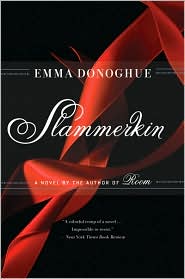
Emma Donoghue's "Slammerkin"

I have vague memories of Katherine reading Slammerkin in high school. She recommended it to me at the time, and I filed away that recommendation for later - whenever later arrived. Practically the second after finishing Room, I ordered Slammerkin. While waiting for it to arrive, I learned a little more about my new favorite author. Emma Donoghue was born in Ireland, spent several years living in England, and now lives in Canada. Her work is prolific and wide-ranging. I am actually very happy that I didn't learn too much more about Donoghue before reading Slammerkin. Room, I discovered, was actually rather unique within the Donoghue canon. She is most known for her historical fiction, but Donoghue has also written screenplays for both the stage and radio. She is also publishes works of literary criticism, including editing collections like Passions Between Women: British Lesbian Culture 1668-1801 and Inseparable: Desire Between Women in Literature. Much of her work, as is apparent from the titles, has lesbian undercurrents or themes. Though I have not read all of her works, I think this is one more thing that makes Room unique in her canon. It's also one of those obnoxiously definitive characteristics that you have to overcome as a reader. Things like Emily Dickinson's self-imposed isolation or Coleridge's melancholia. Episodes or characteristics of the author that become so critically important that they serve as a kind of shorthand for any analysis of the author's works. Good literary criticism, in my mind, has to overcome these preconceived prejudices before approaching any work.

All that being said, I knew next to nothing about Donoghue - that she has a PhD in literature from Cambridge, that she is both a lesbian and renowned for her lesbian fiction, or that she is well practiced at historical fiction (and respected for her thorough historical research) - before I opened Slammerkin. I consider this very fortunate. Slammerkin tells the story of Mary Saunders, a working-class girl in the mid-18th century London. Mary was fortunate enough to have a father who prioritized her education, so that even after he died, her mother continued to send her to a school for refinement. Mary's father died in the riots that swept London when England switched to the Gregorian calendar. Apparently the switch required a "jump" forward 11 days, and the working class men felt they had somehow been cheated out of 11 days wages. His death in these riots is sometimes treated with disdain (especially from his widow, who was disappointed in her dreams of becoming a famous London seamstress). It instilled in Mary, however, a desire for improving her status. She refused to be taught her mother's skills as a seamstress, instead vowing to herself that she would someday be one of the social elite who would buy the fancy gowns whom she sees on the streets One in particular catches her eye - a tall woman with a scarred face who has a beautiful red ribbon in her hair. Her desire for pretty things leads her to a ribbon seller who, when she asks for a red ribbon, rapes her and leaves her with a brown ribbon. When Mary turns up pregnant, her mother and stepfather kick her out on the streets.

Mary wanders for hours before falling down in a ditch, where she is raped repeatedly by a passing group of soldiers. The next morning, Doll, the woman with the scarred face, takes her under her wing. After Mary recovers from the clap in Doll's bed, Doll teaches her how to be a prostitute. A slammerkin, as Donoghue says in the opening quotation page, is a "noun, eighteenth century, of unkown origin. 1. A loose gown. 2. A loose woman." Mary's decline into London's underworld only amplifies  her fascination with beautiful things. Doll helps her buy the brightest slammerkins on the streets, "'A loose dress for a loose woman. Ever noticed the words for us all sound drunk?' Doll put on an intoxicated slur. 'Slovenly, slatternly sluts and slipshod, sleezy slammerkinds that we are!" On the streets, Mary learns the three all important rules: never give up your liberty; clothes make the woman; clothes are the greatest lie ever told.

When Mary gets on the wrong side of an enforcer, she flees London for her life, ending up in Monmouth where her mother had an old friend in the clothing business. She lies her way into an apprenticeship with this woman, telling her that her mother had died with a hope on her lips that Mary would learn the trade. The plot follows Mary's attempts to reform her life vying with the desire to be better, to improve her station. She craves the fine clothes she helps her mistress to make for the local elite, and this craving takes her down a very dark road.

Donoghue based the novel on an actual historical character, Mary Saunders, and she includes brief appearances from other real life characters. Though mostly fiction (very little is known for certain about Mary's sensational story), Donoghue's take on her psychology is fascinating. I will say that I think the reviews that talk about Mary's relationship with Doll as homoerotic have been very misdirected by knowledge of the author's own sexuality. Reading without this knowledge, I found nothing that gestured at all towards a sexual relationship between the two. They are very close, which given that they were all each other had and that they both felt responsible for the other seems like it should be a given. The relationship, at the very least, could be considered homosocial, but when talking about friendships in the 18th century, with the advent of sensibility, I'd wager most of the same-sex friendships would appear thus. At any rate, though, Slammerkin was a wonderful, highly recommended read.