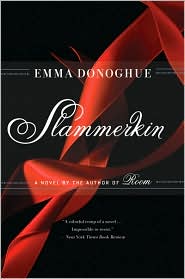
All that being said, I knew next to nothing about Donoghue - that she has a PhD in literature from Cambridge, that she is both a lesbian and renowned for her lesbian fiction, or that she is well practiced at historical fiction (and respected for her thorough historical research) - before I opened Slammerkin. I consider this very fortunate. Slammerkin tells the story of Mary Saunders, a working-class girl in the mid-18th century London. Mary was fortunate enough to have a father who prioritized her education, so that even after he died, her mother continued to send her to a school for refinement. Mary's father died in the riots that swept London when England switched to the Gregorian calendar. Apparently the switch required a "jump" forward 11 days, and the working class men felt they had somehow been cheated out of 11 days wages. His death in these riots is sometimes treated with disdain (especially from his widow, who was disappointed in her dreams of becoming a famous London seamstress). It instilled in Mary, however, a desire for improving her status. She refused to be taught her mother's skills as a seamstress, instead vowing to herself that she would someday be one of the social elite who would buy the fancy gowns whom she sees on the streets One in particular catches her eye - a tall woman with a scarred face who has a beautiful red ribbon in her hair. Her desire for pretty things leads her to a ribbon seller who, when she asks for a red ribbon, rapes her and leaves her with a brown ribbon. When Mary turns up pregnant, her mother and stepfather kick her out on the streets.
Mary wanders for hours before falling down in a ditch, where she is raped repeatedly by a passing group of soldiers. The next morning, Doll, the woman with the scarred face, takes her under her wing. After Mary recovers from the clap in Doll's bed, Doll teaches her how to be a prostitute. A slammerkin, as Donoghue says in the opening quotation page, is a "noun, eighteenth century, of unkown origin. 1. A loose gown. 2. A loose woman." Mary's decline into London's underworld only amplifies her fascination with beautiful things. Doll helps her buy the brightest slammerkins on the streets, "'A loose dress for a loose woman. Ever noticed the words for us all sound drunk?' Doll put on an intoxicated slur. 'Slovenly, slatternly sluts and slipshod, sleezy slammerkinds that we are!" On the streets, Mary learns the three all important rules: never give up your liberty; clothes make the woman; clothes are the greatest lie ever told.
When Mary gets on the wrong side of an enforcer, she flees London for her life, ending up in Monmouth where her mother had an old friend in the clothing business. She lies her way into an apprenticeship with this woman, telling her that her mother had died with a hope on her lips that Mary would learn the trade. The plot follows Mary's attempts to reform her life vying with the desire to be better, to improve her station. She craves the fine clothes she helps her mistress to make for the local elite, and this craving takes her down a very dark road.
Donoghue based the novel on an actual historical character, Mary Saunders, and she includes brief appearances from other real life characters. Though mostly fiction (very little is known for certain about Mary's sensational story), Donoghue's take on her psychology is fascinating. I will say that I think the reviews that talk about Mary's relationship with Doll as homoerotic have been very misdirected by knowledge of the author's own sexuality. Reading without this knowledge, I found nothing that gestured at all towards a sexual relationship between the two. They are very close, which given that they were all each other had and that they both felt responsible for the other seems like it should be a given. The relationship, at the very least, could be considered homosocial, but when talking about friendships in the 18th century, with the advent of sensibility, I'd wager most of the same-sex friendships would appear thus. At any rate, though, Slammerkin was a wonderful, highly recommended read.


No comments:
Post a Comment