Monday, 25 June 2012

Steve Martin's "An Object of Beauty"

Read: February 3, 2012
One of the many book clubs I belong to recently split along common lines: some wanted to read fun, fluffy books, while others wanted more aspirational titles. I initially tried to straddle both groups and doubled up on my reading. I found it amusingly ironic when the first book club, looking for a less artsy choice, picked Steve Martin's An Object of Beauty. Ironic because the book is, after all, about art. It was, however, much fluffier than the second book club's pick, Anna Karenina. Ultimately, I was unimpressed with the book, though it did have some redeeming moments.

An Object of Beauty is a recollection of the narrator's early twenties and the enigmatic, fireball woman he knew (and obsessed over), Lacey. I think the narrator's name was Daniel (it's always so easy to forget narrator's names). The novel follows their path from studying art in school and attempting to break into the art world, Lacey in art auction houses and Daniel in art journalism. The novel is more atmospheric than plot-driven, focusing on the art world during its boom and bust of the late 90s and early aughts and Daniel's obsession with Lacey.

The first part was the most fascinating (and redeeming) part of the novel. Martin clearly is very knowledgeable about the often inscrutable art world. The inclusion of full color images of the pieces of art which the book mentions truly made this a unique experience for me. I have a passing familiarity with some art history, but these pieces really made the book's discussions of modern art, the motivations of art collectors, and the question of how we define value in art come to life.

Despite that, I found Martin's characters very flat. As with Shopgirl, the novel had the feel of an older man remembering his young self and, through that young perspective, an obsession with a youthful beautiful woman. Lacey seemed to be blind ambition incarnate, wrapped in a total disregard for anybody she stepped on along the way. I think it's difficult to write such a one-dimensional character without that person coming off as flat. There's always the question of the unreliable narrator (are Daniel's recollections skewed because he was screwed over by this woman?), but there's no hint towards what Lacey's other motivations may have been. She's something of a femme fatale who uses sex as a weapon to climb her way to the top and thus seems to embody all that is shallow about the art world.

I don't think I would recommend anybody against reading this book. It has the niche quality that suggests that if you think you'd find this interesting (if you love art, for example, or have liked Martin's previous works), than you might love this book. I just don't fit into that niche very well.

PS I'm currently SIX MONTHS behind on blogging what I've read. Oops. Currently in attempts to catch up.

Tuesday, 19 June 2012

Tea Obreht's "The Tiger's Wife"

Read: February 8, 2012
I absolutely loved this atmospheric book. It's a difficult one to summarize, however, so let's just say it's about: storytelling, history, family, memory, mythology, and more.

Natalia is a doctor from a fictitious Balkan country who, on hearing of her grandfather's death, crosses the border to discover more. As she goes, she ponders all of the stories she grew up hearing from her grandfather, many of them tinted with mystery and magic, and none of them decidedly fiction. Scattered throughout the novel are references to the wartorn country, which sounds similar to Obreht's home country Croatia, meditations on what prolonged warfare can do to the psyche, and small potential for a bit of relief in stories and myths.

There is the story of the deaf-mute girl, married to an abusive blacksmith, who befriends a tiger that has escaped from the zoo. This unusual relationship upsets the locals and their superstitions. Natalia's grandfather, then a young boy, attempts to help the girl partly out of a sense of rightness and partly out of a fascination with the tiger.

Perhaps more integral to the overarching plotline is the story of the deathless man, a peripatetic and ageless man whom Natalia's grandfather meets several times throughout his life. As Natalia recounts her grandfather's tales about the deathless man, she begins to question whether her grandfather actually believed the stories she had always thought of as pure myth. In her grief, Natalia begins to wonder if she too could believe in the deathless man, and if so, if he has the answers she wants about how her grandfather died.

Obreht seamlessly weaves past and present, narrative and dialogue, so that you're never quite sure if she's telling you a fact or a myth, and, in the end, the either/or fades into insignificance as you're swept away by the language and imagery.

Monday, 6 February 2012

Susan Cheever's "American Bloomsbury"

Read: January 29, 2012
The conceit behind this literary biography about Ralph Waldo Emerson, Henry David Thoreau, Louisa May Alcott, Nathaniel Hawthorne, and others of their literary circle is a kind of historical novice reaction of amazement that famous people in history knew each other. It reads almost like a gossip magazine for intellectuals. Did you know Louisa May Alcott had a crush on Henry David Thoreau? Did you know that HDT may have had a relationship with Mrs. Emerson? You can almost read between the lines to hear the author's "oh em gee!" of delight.

Suffice it to say, I was not impressed. It's a book that makes all kinds of claims, like the one where a later work of Alcott's embodies Emerson and Thoreau in two male fictional protagonists, without any kind of support or reference. I often have trouble with nonfiction that is nonacademic for this very reason. How could Susan Cheever possibly know, early in the book, that Thoreau walked down the street chewing an apple, dreaming of the dinner his mother would cook. Does that kind of shallow detail warrant such high flung imagination? It's as if Cheever can't decide if she wants to write nonfiction or historical fiction, and so gets caught in the worst elements of both.

Perhaps the thing that I don't understand the most is the sense of pleased surprise Cheever expresses when she discovers that these famous American authors knew each other, and the way she presents this as a kind of lightning moment: a special place, a special time, a special group of people - unpredictable and amazing in its uniqueness. This tone is particularly shocking given the title, American Bloomsbury, which references Woolf and her circle in England. You could also have a similar title referencing the Lake Poets. People who practice the same craft with the same degree of skill tend to find one another and become friends. It's not a unique occurrence nor is it a cause for gasps of "oh em gee."

American Bloomsbury: highly not recommended.

PD James's "Death Comes to Pemberley"

Read: January 21, 2012
Death Comes to Pemberley was highlighted across several of the book recommendation sources I follow. NPR did a segment or two. The New York Times spotlighted it on their weekly emails. Barnes & Noble listed it as a book my previous reading suggested I'd enjoy. Perhaps it was the spirit of the holidays - it's Christmas. Sit down and enjoy a frilly book! Not that I'm in any way opposed to reading frilly books on the beach or on vacation or over the holidays. But that's not how these reviews framed James's most recent addition. They all played up how this master of suspense and mystery writing was combining her expertise with her long held love of Austen. "If you read any Austen sequel, then this one is worth your time," the reviews seem to suggest.

The one thing I will say in its defense is that James tapped into some of the magic of Austen's language. The sentences were nearly pitch perfect, the amusing, subtle, and sometimes underhanded characterizations even more so. It's clear that James is a true Austen aficionado.

However, that's really the only good thing I can say. The plot line was outlandish, even with all sorts of leeway given on the return of your favorite characters. James has Darcy and Elizabeth happily settled with their sons, living a short distance away from Jane and Mr. Bingley. The action starts when Lydia attempts to crash her sister's annual ball, to which she was not invited, but instead is traumatized when Wickham and Denny leave the coach and walk into the woods, arguing. Darcy and company discover Wickham crying, "it's all my fault," over Denny's body. And so goes the mystery.

I think the problem with this adaptation is that Austen's genius was never in her tried-and-true marriage plot. Her novels are not page turners because you want to find out what crazy things will come out of Mrs. Bennet's mouth; rather, you are engrossed because you love the characters. In this travesty of a fan fiction sequel (despite its illustrious author), the primacy is given to the plot and the characters are left to their two-dimensional devices. Elizabeth is, especially, disappointing. She has lost her wit and her gumption and is content to serve as a sounding board for Darcy's musings, to stay at home and send out regretful cancellations to her ball. She's no longer Austen's lovable Lizzie.

Perhaps the reviews gave me too much to hope for, but this was a disappointing holiday read.

Sunday, 5 February 2012

David M Kennedy's "Freedom from Fear"

Read: January 8, 2012
I joined a book club in October based at the Providence Public Library. It's cornily named "History Hijinks" and, from what I've gathered, started with a book on George Washington some four years ago and have been working chronologically forward since then. It's been a pretty fun experience, though I think I joined at a rather special time; they were starting a mammoth book, Freedom from Fear: The American People in Depression and War, 1929-1945. Given it's length, they decided to split it into three months and talk about it in sections. I've debated back and forth about how to handle the many book clubs I've joined re: this blog. I've already decided against writing about every book I read (for example, I've read a couple of light, fluffy books that haven't made their way onto this blog - analyzing any of those kinds of books too deeply just ruins the whole experience). The other question is, am I writing blog entries as a kind of online journal of my own thoughts while reading, or do I think someday I'll start advertising my posts for friends to read (in which case, perhaps I should tailor entries to books I can recommend both in good faith, and with a chance that they might be read). That last one is the dilemma, for I can absolutely say that without the pressure of a book club (or a class, but maybe not even then), I would never have had the gumption to pick up a tome like Freedom from Fear, and finish it. Despite that (and why I ultimately decided to write a blog entry about it), I thoroughly enjoyed it and emerged feeling full of all sorts of important knowledge.
   The book is part of the Oxford History of the United States. (Amusing side note, David has an earlier entry about the Gilded Age, whose title is What God Hath Wrought, but which I glancingly misread as What Hath God Wrought?! - embarrassing, but not nearly as bad as my version of Bertrand Russell's Why Am I Not a Christian? Pesky word order.) Because it is part of this series, Freedom from Fear has quite a burden of expectation. It must connect readers of the earlier installment and follow the story of the American people through to the following installment. I found it an interesting editorial decision to group the Depression and WWII together into one author/installment, which makes a lot of inherent sense but also causes problems for Kennedy which I’ll touch on later.  Despite these burdensome requirements, Kennedy meets and exceeds all expectations with a book of intricacy and breadth. It straddles the line between popular history (a la Howard Zinn) and biographical history (history told through the life stories of key players, i.e. old white men), a combination which satisfyingly gives the reader key players to learn and follow while not myopically ignoring the peons.
The structure of the book reflects the two separate narratives: Depression and War. The first “book” was published separately and tells the story of the socioeconomic conditions in 1929 in the US and abroad, the coming of the Great Depression, Hoover’s attempts to handle unprecedented circumstances with an outdated theory of government,  Roosevelt’s meteoric Hundred Days, and the often skimped years between Roosevelt’s first year and the start of World War II. My oversimplified understanding of this period ran something like this: Speculation runs rampant in the Roaring Twenties, stock market crashes, Depression begins, Hoover doesn’t care enough to do anything about it, Roosevelt is elected, starts a bunch of alphabet soup organizations and uses government demand to pull the country out of the Depression, flash forward eight years and it’s Pearl Harbor (side note: the war actually cures the Great Depression, but without really explaining what effect Roosevelt’s ABCs have). Oh, and there was a Dust Bowl.  If I were to recount all the ways in which this tale was oversimplified, I would need to write a book (as Kennedy has done), so instead, I’ll just speak of a couple.
First, the agricultural economy had been in Depression-like circumstances for several years prior to the 1929 crash. A combination of bad weather conditions and a stubborn surplus left over from feeding Europe during WWI led to bad crops and low grain prices. The economy was still primarily agricultural in the 1920s, so when there are problems in this sector, it will eventually infect the rest, which is what happened. All the farmers who couldn’t sell their grain started to move to the cities looking for work. Enter the ’29 crash when all the rampant speculations spectacularly fell through, which prescient economics observers had predicted for years. Significantly, Kennedy demonstrates that the ’29 crash alone did not cause the Depression, nor was it that unique. For the fifty years previously, the boom-and-bust economy had gone through similar patterns and always recovered; the ’29 crash is special because it had followed an unusually long period of boom and was followed by an unprecedentedly long period of bust. Economists still argue about why this was the case; what made the Depression so entrenched? Hoover, as Kennedy shows, gets an undeserved bad rep for the economy. He was the product of years of economic theory. Though not the apostle of laissez faire historians often paint him as, he did advocate a hands-off approach to the economy, instead believing in voluntarism to solve capitalism’s shortcomings. (For the book club in February, we read a biography of Herbert Hoover, which was less complimentary than Kennedy was, so I remain a little uncertain about what I think of Hoover’s presidency; generally, however, he doesn’t deserve the many varied aspersions he receives.)  Kennedy does argue that Hoover’s slow and nonexistent actions to spur the economy meant that by the time of Roosevelt’s ABC organizations, the economy was entrenched in Depression, mostly because of unemployment (no wages, no consumers, no demand, no jobs).
Kennedy maintains a good balance between describing the everyday conditions for the average American and interspersing that with Roosevelt, his cabinet, Congress, and the attempts to “fix” the economy. History describes a Roosevelt who instinctively knows what the economy needs and hits the ground running with his First Hundred Days to address those needs. Kennedy, instead, tells of a Roosevelt as inscrutable as he was eloquent. His ability to inspire the people over the radio with platitudes and encouragement ran contrary to his tendency to adopt conflicting policies. Kennedy describes Roosevelt’s solutions as an “everything but the kitchen sink” approach – throw everything at the economy and hope it works. True, this was quite a departure from Hoover, but Roosevelt was also very concerned about the ill-effects of putting Americans “on the dole” – not nearly as revolutionary as his reputation suggests.
There were a couple of moments that struck me in their symmetry to our current political and economic situation. Kennedy described Hoover as a man of principle who wanted decisions to be reached via conferences and communal decisions, appealing to the better angels of men’s natures, and couldn’t see when his opponents were more stubborn about their principles than about the greater good. Chillingly close to criticisms of Obama. Another troublesome parallel was Kennedy’s description of the Depresssion as an economic downturn due to the inadequacy of the old workforce – too many previous farmers who couldn’t continue that occupation and also couldn’t find work in a new job. Thus, why the demand for manufacturing created by the war pulled the country up. Perhaps the idea of the kind of productivity America achieved to get ready for war was just as unimaginable to men and women then as a similar kind of major change to our economy is to us.
The transition to discussion of the War was awkwardly made. I think, mostly, this decision was made because of the publication of the book in two separate books – Kennedy needed to wrap up the Depression for the first publication and then begin with the War for the second publication. Reading straight through meant that one chapter ended with the effects of the New Deal and the Depression in a long perspective and the next chapter started with the relationship between Churchill and Roosevelt throughout the 1930s. I think this was made even more awkward because you lost the narrative of “the people” in favor of the geopolitical relationship between two men. Kennedy didn’t pick up the people’s narrative for several hundred more pages.
A couple of things I learned/were reinforced. America was incredibly isolationist. The perspective on the first World War was that America was unnecessarily involved in a pointless war because of Europe’s old world grudges and that the American boys who died were lost without a cause. Understandable, then, that they did not want to do it over again. Unfortunately, this attitude also meant that Americans wanted Europe to pay for everything the War cost. Thus, you get this series of debts. America loans Germany money to pay England and France the agreed debts from the Versailles Treaty, which England and France then use to pay back loans from the US. Germany’s Depression and the punishing debts paved the way for Hitler and the reluctance to repeat WWI meant that the rest of Europe was willing to turn a blind eye.
Roosevelt knew that America would have to enter the war long before it was politically expedient for America to do so. Churchill was painted as something of a beggar, which I objected to because this simplistic portrait of a very complicated politician ignored his role in the UK and Europe. It’s somewhat excusable because Freedom from Fear is, ultimately, a history of the United States, but still I found it grating. There are several “what if” moments in the lead-up to war. If the Japanese had not attacked Pearl Harbor, there did not seem to be much of anything that would change the staunch isolationism of the American public. The reasoning for the attack on Pearl Harbor were the increasing economic sanctions against Japan for its imperialist attacks on China, but Roosevelt had intended to design these economic sanctions so as to keep the pressure only enough to punish, but not enough to provoke. Unfortunately, Roosevelt was at a conference when the worst of these sanctions (oil embargo) went into effect, and so it was enforced much more stringently than he intended. Another “what if” moment is the fact that Hitler declared war on the US immediately following Pearl Harbor. If he had not done this, would Roosevelt had been able to redirect the American public away from the attack from Japan and towards the Western Front?
One thing Kennedy does amazingly well is impress on his reader the huge extent of America’s industrial power – and its ability to win the war. Isolationist America faced December 7th woefully unprepared for war and despite this, they were able to turn around and build more than the rest of the war’s participants combined. Kennedy makes the very interesting point that this might not have been the case were it not for the Depression. Without the silent factories and long lines of waiting employees, the economy would not have been able to slow down pre-Depression manufacturing levels and change course as quickly as they were under Depression conditions. I have to admit, the descriptions of the Eastern campaign were not nearly as well known to me as the tales of the battles in Europe. Both were told in ways that did not get bogged down in descriptions of troop movements and soldier conditions. The overarching narrative of war in the Pacific, however, is often glossed over in textbooks. In Kennedy’s book, it was perhaps more emphasized than the European battles. Kennedy tells how the Eastern front was a war of race and prejudice in ways that the Western war was not. For the Japanese, surrender was considered worse than death, the highest dishonor possible, which explains why the island hopping war was a war of attrition rather than strategy.
I feel I could go on and on, but never touch the things that I learned in this book. Reading history for extracurricular/intellectual reasons is a truly unique experience. I doubt I would have been motivated to finish the book had it not been for the monthly deadlines (history books being especially prone to the lack of desire to pick up a book), but I am very grateful that I did. Maybe now that I’ve accomplished it with this book, I could do it on my own, but I remain grateful for the book club that will inspire me to continue reading nonfiction history books. I highly recommend this treatment of the Depression and WWII.

Monday, 16 January 2012

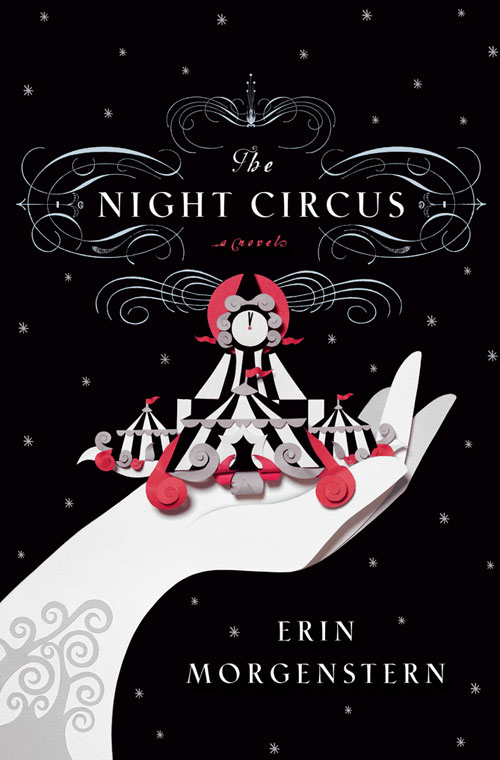
Erin Morgenstern's "The Night Circus"

Read: December 19, 2011
I absolutely loved this book. I heard about it from an NPR interview with the author. Granted, I'm a sucker for anything marketed (or even described in passing) as "Harry Potter for adults," but the author sounded like a really fascinating person, so it quickly jumped to the top of my reading list. It was nicely ensconced there when I had my first book club meeting via meetup (the one where we were supposed to read The Elegance of the Hedgehog, but ended up reading State of Wonder), and so I advocated for either it or The Tiger's Wife (which might be my next fiction read). It was the only physical book I brought with me to Belfast for Christmas (the nook is so great for traveling!) and I read it in two, maybe three days.

As a book from the magical realism genre (think The Time Traveler's Wife or One Hundred Years of Solitude), it's difficult to describe the plot. So much of these books necessarily require world building - some explanation of how the magical elements function. In The Night Circus, magic is a real, though mostly secret, force in the world, accessible to those with an aptitude, either innate or self-taught. There are two competing schools of magic: one, held by Prospero (stage name), argues that magic is a skill a person is born with and which practice can improve and perfect; another, held by the man in the grey suit (unnamed), believes that magic is based on theory which can be taught and a deeper understanding of these theories and ideas will make a stronger practice. These two competing schools, if you will, have in the past bound their students in competition with each other to discover which of the two is the stronger, and by extension, posits the true understanding of magic.

As children, Marco and Celia are bound to each other as competitors, though they are told almost nothing about this binding or the details of the competition. Prospero proposes the competition and thus chooses the location of the competition in a magical circus. Thus, Les Cirque du Reves is born - a beautiful circus completely decorated in black and white, consisting of multiple tents with a wide variety of magical and seemingly magical exhibits, and one which takes place only at nighttime. As Prospero's student, Celia is the circus's illusionist, who hides her magical abilities in what seem to be almost impossible stage tricks. Marco, her opponent, begins as a consultant for the circus's designer, influencing the circus from afar. In this magical world, Celia and Marco stage increasingly impressive displays of magic, discovering each other in the process, and the awful truth that this competition to which they have been bound is one in which there is only one winner, one survivor.

The story is told through a few interrelated plot lines. One, perhaps the most unique, describes the experience of a circus attender in second person. The book begins, "The circus arrives without warning...yet as dusk approaches there is a substantial crowd of spectators gathering outside the gates. You are amongst them, of course. Your curiosity got the better of you, as curiosity is wont to do. You stand in the fading light, the scarf around your neck pulled up against the chilly evening breeze, waiting to see for yourself exactly what kind of circus only opens once the sun sets." What a hook! This opening chapter quickly establishes the aura of magic and mystery that permeates the novel, as well as the unique methods Morgenstern will employ to tell her tale. The plot also progresses with quotes pulled from "books" written by Frederick Thiessen, an expert and primary fan of The Night Circus. Morgenstern tells the story of Marco and Celia's separate childhoods, magical training, and how they become involved in The Night Circus. Finally, the novel narrates a "contemporary," that is a plot line that occurs concurrently with the climax of Marco and Celia's plot line, story of a young farm boy who falls in love with the circus. These last two plot lines require the reader to pay attention to the dates at the top of the chapters in order to keep events in chronological order, though this does not detract from the overall effect.

I would highly recommend this book to anybody who is interested in magical realism, who wants to fall into a book and learn the rules of the world its creating, and who yearns for that depressing pleasure of missing the characters and the world once the last page is turned. I also advise that people read this book in paper form. Ironically, I believe, this book is impeccably designed and detailed in a way that would not be possible to read in ebook form, but which also would not have been possible to publish were it not for the threat of ebooks to publishers. Several news stories lately have talked about how publishers are now taking two approaches to publishing: a quick and easy ebook for the pulp fiction and a beautifully designed and wrapped book for the kind of book people want to treasure on their shelves. Seems to match my style of reading! This book is definitely part of the latter group - buy it in hardback/paperback!

Saturday, 3 December 2011

Ann Patchett's "State of Wonder"

Read: November 19, 2011

This book was my first exposure to Ann Patchett, who from the reactions some have given me to that statement seems to be a relatively popular author with a devoted fanbase. I came across this most recent of her books because a book club I joined first picked The Elegance of the Hedgehog before giving it up (much to their loss, in my opinions). I will give the caveat here that reading State of Wonder under the shadow of Elegance of the Hedgehog probably influenced my reading of the former. They are very different kinds of novels. As I mentioned in my earlier post, Elegance of the Hedgehog is a very cerebral book that relies almost exclusively on characterization and witty language. State of Wonder, in contrast, emphasizes atmosphere over character.
State of Wonder follows Dr. Marina Singh, a research scientist at a pharmaceutical company in Minnesota. Originally trained as an OB Gyn, a horrific experience as an intern under the inimitable Dr. Annick Swenson’s mentorship led Marina to leave her internship and take up a research position. The novel opens with the news that Marina’s co-worker, Anders, has died in the Amazon jungle on a business trip to investigate Dr. Swenson’s work on a malaria vaccine. Marina’s boss, Mr. Fox, with whom she has a secret relationship, sends her to continue Anders’ investigation and, at Karen Eckman’s request, to learn more about Anders’ mysterious death. Once in South America, the novel finds its stride in the descriptions of the intense heat, heavy air, and dangerous insects. Marina’s antimalarial medicine gives her horrific nightmares about her father, an Indian man whom Marina and her American mother would visit infrequently. In these dreams, Marina loses her father in a large crowd of people and faces that inexplicable terror of nightmares. Once Marina successfully finds Dr. Swenson, who at 70 is just as abrupt and irascible as Marina remembers, the novel shifts focus away from the Anders mystery to a tree bark that gives both malarial immunity and lifelong fertility.
The atmospheric language that so aptly describes the sticky heat of the Amazon moves slowly through the plot and gives the impression that the story barely moves forward. Marina spends quite a long time in Manaus, a city in Brazil, before she makes it into the jungle and the plot gets very bogged down there. Perhaps my greatest complaint, though, is that with the shift of focus away from Anders and to the mystery of the tree bark, the ending (not to give away any spoilers) has the distinct feel of the deus ex machina (not to mention overly Hollywood in a way that is even more disappointing in print). Marina, as a character, is a rather passive woman with obvious daddy issues (both in her memories of her father and her relationship with Mr. Fox) and who seems incapable of making herself heard. I think it would be quite a challenge to write a main character like this, who is the perspective of the story but who does very little herself to push the story forward. I think in this she is a very realistic person, but the conclusion leaves her story feeling unfinished (and obviously lacks any state intention on her part).
Ultimately, I would not recommend this book. It might be one that I should return to and reevaluate outside of the context I mentioned above, but ultimately, I think there wasn’t enough in the book to make me return to it.